US Senate Republicans Release Updated Clarity Act Draft With New Ethics Package
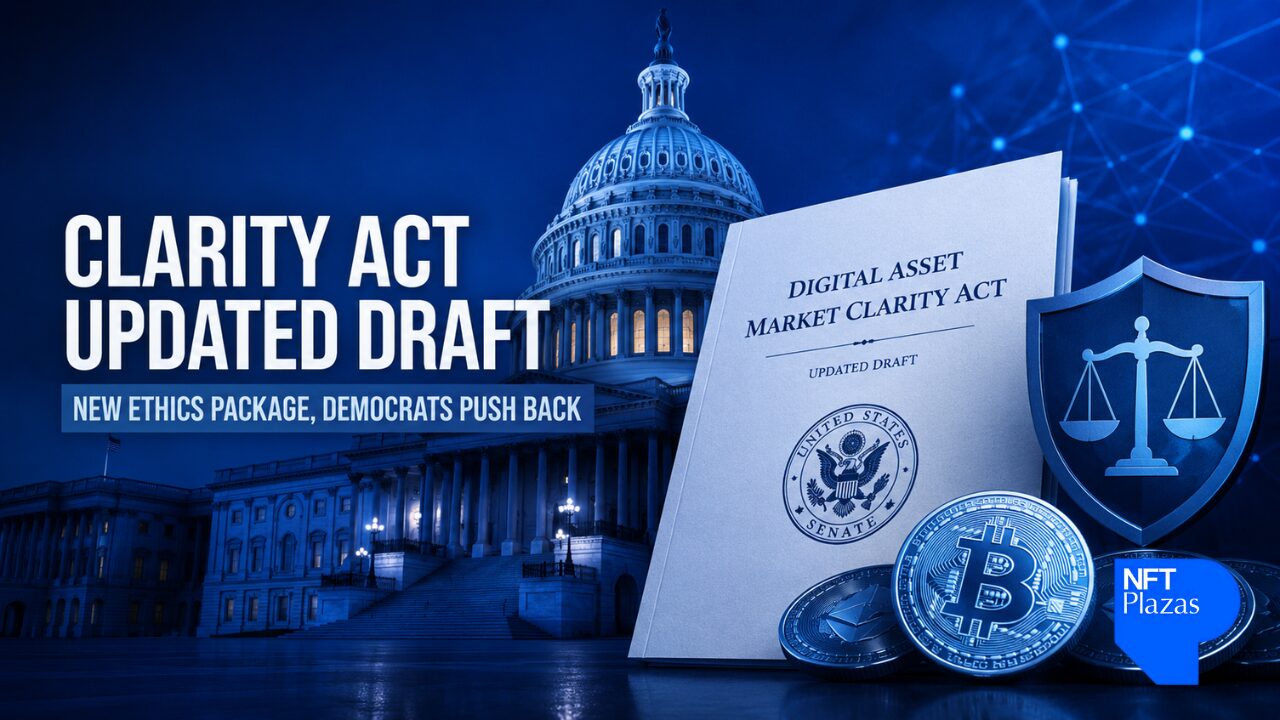
Senate Republicans on Wednesday released an updated draft of the Digital Asset Market Clarity Act, unveiling a long-awaited ethics package negotiated with the White House just as lawmakers race to bring the crypto market structure bill to a floor vote before the August recess. The new text merges language from the Senate Banking and Agriculture Committees and, for the first time, includes conflict-of-interest rules covering the president and other senior officials, a provision Democrats have demanded for more than a year.

US Senate Republicans released new crypto Clarity Act draft bill
What the ethics package does
The revised bill would bar the president, vice president, members of Congress, federal judges, and other covered officials, along with their spouses, from issuing or sponsoring a digital asset for compensation while in office. Covered officials would be required to either sell their crypto holdings and any stakes in crypto-related companies, place those assets in a blind trust they do not control, or both, following procedures modeled on existing federal ethics-agreement rules. The restrictions would sunset at noon on January 20, 2029, meaning no penalties could apply to conduct occurring after that date.
Enforcement would fall to the Department of Justice, which would gain civil authority to sue officials who knowingly violate the rules, as well as exchanges that knowingly list tokens issued in violation of the provision. Violators could be forced to surrender profits and pay civil penalties, and officials would need to disclose crypto sales exceeding $1,000. The Government Accountability Office would study whether additional ethics safeguards are needed.
The draft explicitly excludes state attorneys general from bringing enforcement actions, specifying that only the U.S. Attorney General may sue under the section. It also preserves a separate carve-out allowing continued commercial use of an official’s name, image, or likeness if an issuer had already used it before that person entered covered status.
Beyond the ethics language, the draft retains the Blockchain Regulatory Certainty Act, which would keep non-custodial software developers from being classified as money transmitters, and adds a new section aimed at bolstering law enforcement’s ability to pursue crypto-related crime, including expanded funding for blockchain investigations, training, and a new cyber center focused on threats from countries such as North Korea and Iran. Stablecoin issuers would be required to comply with lawful orders to freeze, seize, burn, and reissue tokens, and the bill outlines how customer assets would be treated separately from a company’s estate in the event of an exchange or custodian bankruptcy.
Political reaction splits along familiar lines
The White House approved the ethics language on July 21, following talks between Republican senators, including Wyoming’s Cynthia Lummis and Ohio’s Bernie Moreno, and administration officials. Lummis called it one of the most comprehensive ethics provisions ever attached to legislation and urged the Senate to pass the bill without delay. Digital Chamber CEO Cody Carbone called the draft a meaningful step toward a floor vote.
Democrats were far less receptive. Seven Democratic senators, including Catherine Cortez Masto, Angela Alsobrooks, Cory Booker, Ruben Gallego, John Hickenlooper, Mark Warner, and Raphael Warnock, issued a joint statement saying the text falls short on ethics, consumer protection, illicit finance, and conflicts of interest. Alsobrooks, one of two Democrats who backed the bill in committee, called the DOJ-only enforcement structure “an unserious offer” and said she would not support the bill with that language, though Democrats intend to keep negotiating. Gallego voiced similar concerns, arguing the text still leaves loopholes for officials’ crypto dealings.

Political reaction splits along familiar lines (Source: Eleanor Terrett’s X)
The enforcement dispute carries particular weight given President Trump’s crypto holdings. Financial disclosures showed Trump earned more than $1 billion from crypto ventures last year, with roughly $580 million tied to World Liberty Financial, a venture co-founded by Trump family members that issues the WLFI token and USD1 stablecoin. Banking trade groups also flagged the draft’s stablecoin-yield provisions, saying the language still risks local lending activity.
What the underlying bill still does
Beyond the ethics fight, the Clarity Act remains an attempt to give the industry a regulatory rulebook by dividing oversight between the SEC and CFTC. The legislation would classify tokens, set registration and disclosure rules for exchanges, and direct regulators to build a pathway for tokenized securities and futures trading on public blockchains. Solana Policy Institute CEO Miller Whitehouse-Levine said the bill would offer clearer treatment for token fundraising and stronger consumer protections, while banking trade groups continue to push back on the draft’s stablecoin-yield language.
A narrowing timeline
The bill has already cleared major hurdles. The House passed its own version, H.R. 3633, 294-134 in July 2025. The Senate Banking Committee advanced its version 15-9 in May, with two Democrats joining Republicans, while the Agriculture Committee passed its companion measure covering CFTC jurisdiction earlier in the year. Majority Leader John Thune has signaled he intends to bring the merged bill to the floor as soon as next week regardless of Democratic support, though passage still requires 60 votes.
The Senate has only a handful of working days left before the August recess, widely seen as the last realistic window to pass the bill in 2026 before focus shifts to the midterms. Prediction markets tracking the bill’s odds of becoming law this year have slid into the low-to-mid 30s percent range since the draft’s release, reflecting doubt over whether the remaining gap can close in time.