Starkware Mines Quantum-Safe Bitcoin Transaction on Mainnet
Key Takeaways
- Starkware’s QSB made a quantum-safe bitcoin transaction on Aug. 26 with zero consensus changes.
- Bitcoin gains an opt-in quantum hedge, but QSB cost $150-$200 and required hours of GPU work.
- Starkware still wants a Bitcoin soft fork after the QSB test; exposed keys remain a network risk.
Starkware Shows Bitcoin Can Add Quantum Defense Without a Fork
Bitcoin passed an unusual quantum-computing test: protecting a transaction without changing Bitcoin itself.
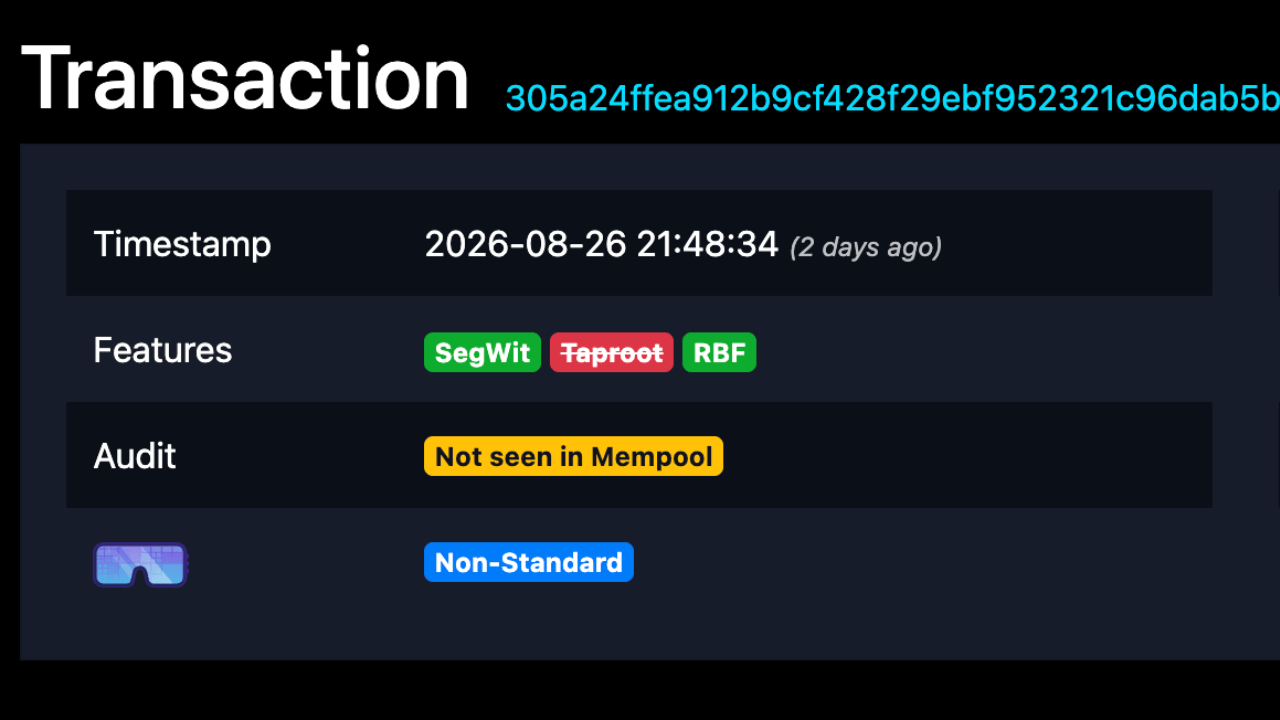
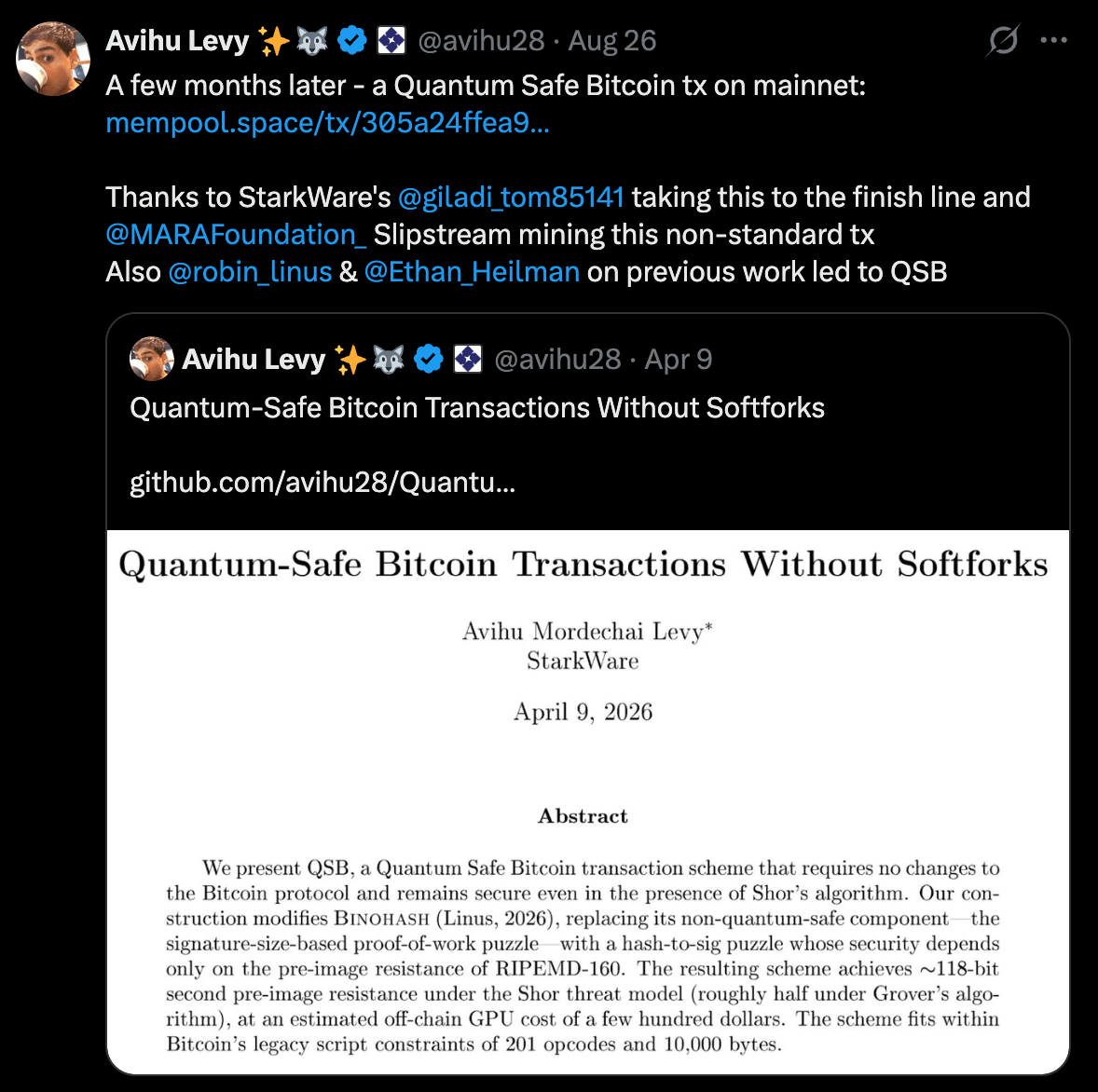
On Aug. 26, a transaction using researcher Avihu Levy’s Quantum-Safe Bitcoin (QSB) construction was mined on the Bitcoin mainnet. Starkware described it as the first post-quantum-resistant bitcoin transaction executed under the network’s existing consensus rules.
“Last night, we submitted the first QSB transaction on Bitcoin mainnet,” Starknet Foundation Vice President of Growth Damo said during a Bitcoin Asia keynote. “It required no soft forks, it required no hard forks, it required no core protocol upgrades.”
The transaction spent a 10,000-satoshi output and was mined through MARA Foundation’s Slipstream service because its nonstandard format would not normally propagate through Bitcoin’s public mempool.
QSB Replaces Signature Risk With Hash-Based Security
Bitcoin spending relies on elliptic-curve cryptography, which could eventually be vulnerable to sufficiently powerful quantum computers running Shor’s algorithm.
The risk becomes particularly important once a public key is exposed. A quantum attacker could theoretically derive the corresponding private key and attempt to redirect funds before a legitimate transaction confirms.
QSB approaches the problem differently. Levy’s design adds a quantum-resistant spending condition based on hash functions and uses a technique known as signature grinding. Much of the computational work happens offchain before the transaction is broadcast.
The mainnet test reportedly required hours of GPU computation and cost roughly $150 to $200.
Levy first published the research in April before Starkware engineer Tomer Giladi helped bring the construction to a working mainnet transaction. Levy also credited earlier work by BitVM creator Robin Linus and researcher Ethan Heilman.
Proof of Concept Is Not a Quantum Fix for Bitcoin
The result does not make bitcoin itself quantum-resistant.
QSB remains opt-in, and funds must be moved into the protected construction before they are threatened. It cannot recover lost coins or protect funds whose public keys have already been exposed long enough for a future quantum attacker to target them.
Starkware CEO Eli Ben-Sasson also continues to favor a protocol-level solution.
“I still want Bitcoin to choose to do a soft fork, and I expect we will get one,” he said. “What today’s successful transaction offers bitcoin is a reassurance that holdings can be protected before that happens.”
For bitcoin, that distinction matters. QSB does not settle the debate over quantum migration, but it shows that holders may have an emergency path before consensus-wide protections are ready.