
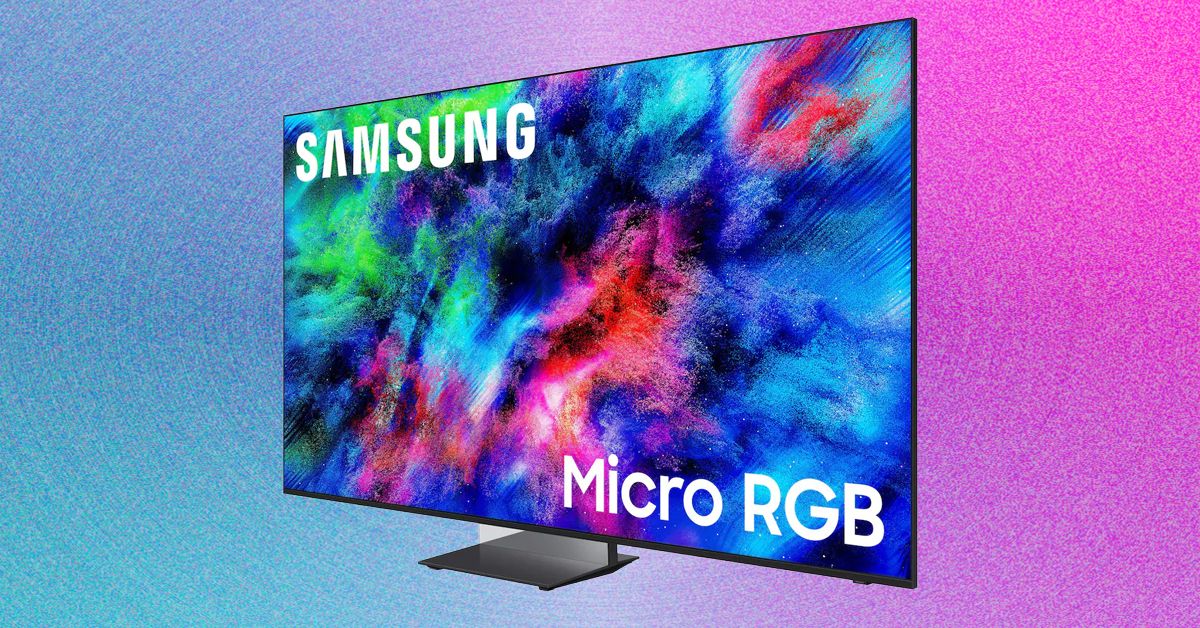
Samsung Micro RGB R95H Review (2026): Not the Brightest
I tested Alexa+ and was mostly pleased with how it worked, allowing me to adjust the volume and search for obscure ’90s psychological thrillers. You can enable the Alexa voice prompt and skip the mic button on the remote, but that didn’t work as reliably as I would have liked. A few times, saying “Alexa” didn’t trigger the TV.
Benched on Benchmarks
Benchmarks don’t lie, or at least that’s the theory. We all see colors differently, and we respond to contrast and brightness based on our own visual perception. While the R95H met all of the BT.2020 color gamut specs, results of the Spears & Munsil Benchmarks made clear that the R95H’s performance is not as outstanding as that of competitor LG Micro RGB Evo. I could tell skin-tone variance on the Samsung was not quite as obvious: two people who don’t look that similar, complexion-wise, looked about the same on the screen.
Picture-quality settings didn’t help that much. Dynamic mode (which other TV makers call Vivid) caused some color blooming and bleeding, and Filmmaker mode made the skin tone scene too dark. The AI picture setting worked the best, especially for soccer, but most of the tweaks related to contrast and brightness didn’t help as much as they did on the LG.
Similarly, the demo reel tests were not as impressive as I would have expected for new display tech. The green grass behind a wooden fence was not as bright as I would have liked for a premium TV. The white mist over a snowy mountain was clearly visible but a little washed out. Picture modes and tweaks to white balance, brightness, and color temp didn’t help that much, either.
The actual LCD screen and anti-glare tech that Samsung uses on the R95H made this TV less susceptible to picture-quality tweaks than the LG or Hisense RGB models I tested. On the LG Micro RGB Evo specifically, simple tweaks to color temp and white balance had a more noticeable impact on picture quality, as did most picture modes. For example, using Vivid picture mode improved the benchmark tests, while Dynamic mode on the R95H didn’t move the needle. Buffalo roaming on a field looked a bit flat due to the anti-glare tech. Dark trees in a mountain scene were not distinct enough from the dark background. A yellow flower looked oversaturated using Dynamic mode but too flat and dull using Filmmaker mode.
Testing the Not-So-Brilliant Colors

Photograph: John Brandon
In testing the R95H, I learned that color processing is hugely important on micro RGB televisions as opposed to OLED televisions, because the colors have to be constantly rendered.