Project Faro: 21 Banks Commit $270 Million to New Stablecoin Venture for 2027 Launch
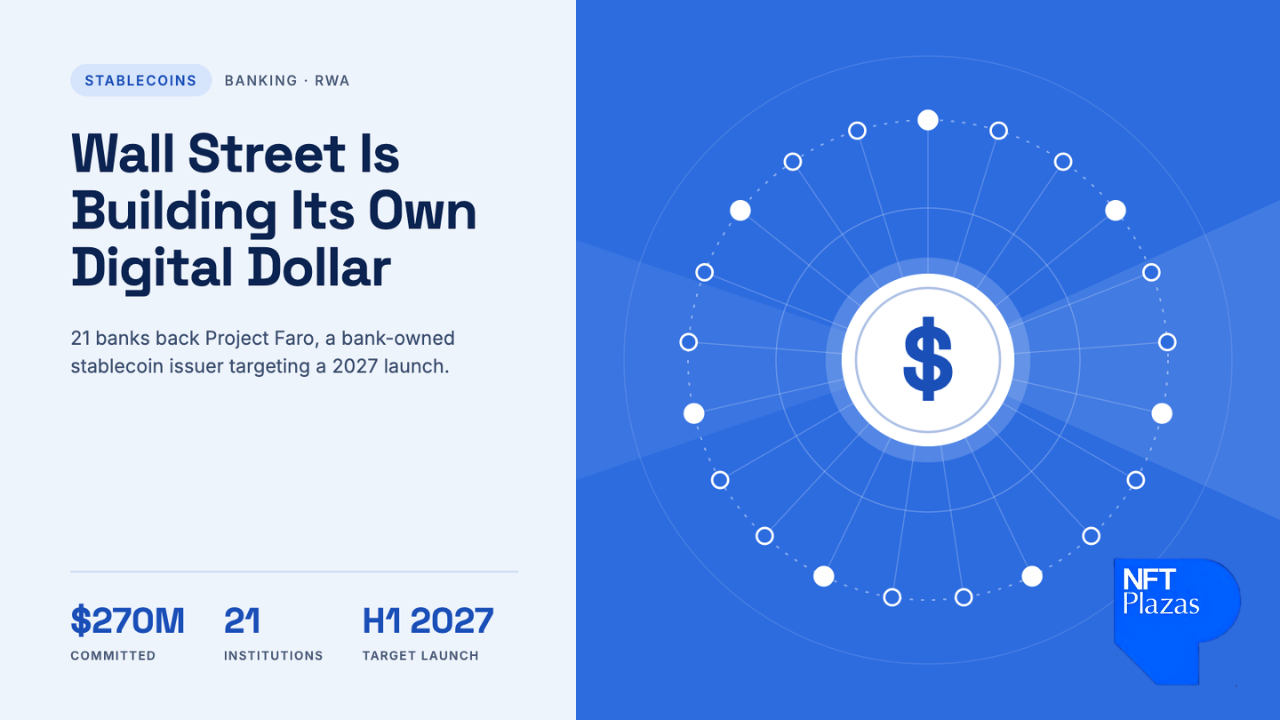
21 global banks, led by Goldman Sachs and Citigroup, have committed about $270 million to Project Faro, a U.S.-incorporated issuer aiming to launch a dollar stablecoin in the first half of 2027. The bet is less about payments than control: by issuing their own token instead of relying on USDC or USDT, the banks keep the reserve income, write their own compliance rules and stake a claim to the cash leg of tomorrow’s tokenized-asset markets.
A $270 million bet on bank-built digital dollars
Wall Street has stopped experimenting with stablecoins and started funding one. A consortium of 21 financial institutions, including Goldman Sachs, Citigroup, Banco Santander and Deutsche Bank, has committed about $270 million to Project Faro, a joint venture that plans to issue a U.S. dollar stablecoin in the first half of 2027, Bloomberg reported on Tuesday, citing people familiar with the matter.
The money is meant to cover five years of operating costs for the new company, which is expected to be incorporated in the United States. Wells Fargo, Fidelity, MUFG, Standard Bank and BBVA are also involved. When the group went public in September, its roster also included Bank of America and UBS.
The dollar token is only the first step. Faro plans to issue stablecoins pegged to every G7 currency, with a euro coin next in line. The venture is still searching for a chief executive, has not settled on a public name and has not disclosed how much each member is contributing. The banks did not immediately respond to requests for comment.

A $270 million bet on bank-built digital dollars
Why not just use USDC or USDT?
On paper, the banks could simply route client flows through existing stablecoins. Tether’s USDT and Circle’s USDC make up roughly 85% of a market worth about $290 billion, according to DefiLlama data, with USDT near $176 billion and USDC near $70 billion. Both are liquid, battle-tested and live on most major blockchains.
The catch is who keeps the money. A stablecoin issuer earns the yield on the reserves behind its tokens, usually cash and short-term Treasuries. Every dollar a corporate client parks in USDC is a dollar whose float accrues to Circle, not to the bank that owns the relationship. For institutions built on deposits, that is a slow leak they cannot afford to ignore.
Control matters as much as revenue. A bank-owned issuer lets members write their own rules on compliance, customer checks and frozen funds, instead of depending on a third party’s policies. The consortium says its token is designed to comply with the U.S. GENIUS Act and, where relevant, the EU’s MiCA regime, a regulatory perimeter that bank risk committees already understand.
The real prize: settlement rails for tokenized assets
Faro’s ambitions reach beyond payments. In its September announcement, the group said the coin would serve wholesale, institutional and retail markets, naming cross-border payments and digital asset settlement as core uses.
That second use is where the stakes rise. As bonds, money market funds and other real-world assets (RWAs) move onchain, every tokenized trade needs an onchain cash leg to settle against. Whoever issues that cash token sits at the center of the plumbing, seeing the flows and shaping how settlement works. Banks that already dominate custody, clearing and correspondent banking have little appetite for handing that seat to a crypto-native firm.
A shared issuer also solves a coordination problem. A token minted by one bank tends to stay inside that bank’s walls. A neutral coin backed by 21 institutions spanning North America, Europe, East Asia, the Middle East and Africa has a better shot at becoming common settlement money between them, closer to an industry utility than a proprietary product.
A crowded, overlapping field
Faro is not alone. In June, more than 140 companies, including Stripe, Visa, Mastercard and BlackRock, lined up behind Open USD, a business-focused dollar stablecoin. In Europe, the Qivalis banking consortium has grown to 37 members and won authorization as an electronic money institution from the Dutch central bank in October, ahead of a planned euro token.
The memberships blur together. BBVA sits in Faro, Open USD and Qivalis. Rabobank belongs to both Faro and Qivalis, and BNP Paribas, one of the ten banks that first explored the Faro concept in October 2025, later joined Qivalis. Rather than backing a single winner, big banks appear to be buying options on several versions of the future of digital cash.
Some are also going solo. Fidelity has launched its own FIDD dollar token, and Societe Generale’s crypto arm already issues euro and dollar stablecoins, a reminder that the consortium model is one path among several.
What to watch before 2027
Distribution is Faro’s strongest card. Its members already serve vast retail and corporate client bases, so the token would not need to build an audience from scratch the way crypto issuers did. The harder task is converting those relationships into real onchain activity, where USDT and USDC enjoy deep liquidity and years of network effects.
Governance is the second test. Twenty-one shareholders with different home regulators, priorities and rival side bets must agree on a CEO, a brand, blockchain choices and reserve management, all before a launch window now less than a year away.
If Faro succeeds, the stablecoin market’s center of gravity could shift from crypto firms toward the banks that already run global finance. If it stalls, the $270 million will still have bought its members something valuable: a seat at the table while the rails for tokenized money are laid.