Grayscale Tracks 580% Crypto Winner Targeting AI Computing Revenue
Key Takeaways
- Grayscale reports PEARL gained 580% over three months through Oct. 22.
- DATA aims to turn human-contributed training material into paid datasets.
- USD.AI channels blockchain capital into loans secured by computing hardware.
PEARL’s 580% Gain Puts AI Computing Rewards in Focus
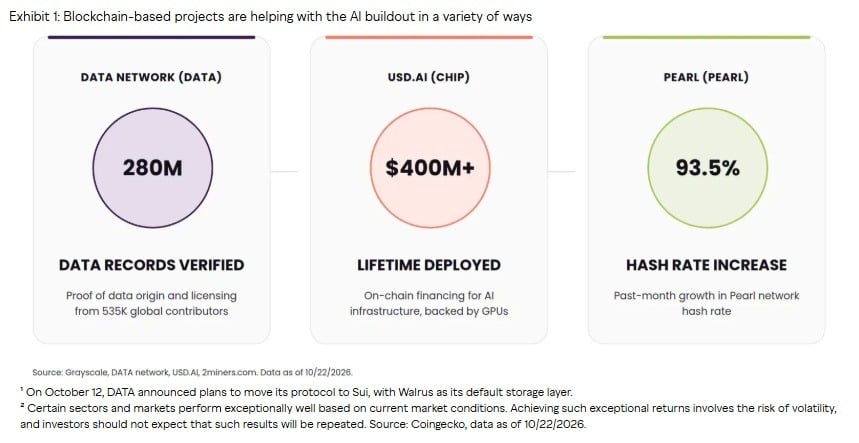
Blockchain projects are developing ways to earn revenue from AI infrastructure, with PEARL among three examples highlighted by Grayscale on Oct. 23. Zach Pandl, head of research at the digital asset manager, examined PEARL, DATA Network, and USD.AI as examples of blockchain applications in AI infrastructure.
Pearl, a blockchain project focused on AI computing, aims to let graphics processing units (GPUs) perform AI tasks while simultaneously securing a proof-of-work blockchain. These chips perform many calculations in parallel. Operators could earn blockchain rewards alongside payments for AI services.
The analysis reported PEARL’s 580% gain over three months, citing Coingecko data through Oct. 22. Pandl qualified the projects’ prospects:
“Their long-term relevance will depend on adoption and competitive economics.”
DATA Targets Paid Contributions to AI Training
Human-contributed photographs, videos, and voice recordings form the basis of DATA Network’s approach to supplying material for AI development. The project is building collection, licensing, and tracking tools. Applications using its infrastructure could license datasets to AI laboratories while rewarding the individuals who supplied the information.
Training data is material that models process to learn patterns, making its quality and variety relevant to their capabilities. DATA announced plans Oct. 12 to move its protocol, the software and rules governing its operations, to the Sui blockchain and use Walrus, a decentralized file-storage network, as its default storage layer.
USD.AI Connects Blockchain Funding With GPU Loans
Expensive computing equipment creates financing needs that USD.AI, a blockchain-based lending platform, addresses through loans secured by GPUs and their associated cash flows. Its GPU financing terms describe funding of up to 80% of deployment costs, subject to credit review and eligibility. Borrowers contribute at least 20% of the cost themselves and repay principal over three to five years.
Pooled capital can fund those loans and potentially generate returns for participants. More broadly, decentralized finance lending uses blockchain software to administer financial transactions. Participants remain exposed to borrower defaults, collateral losses, and software failures.
Institutional backing for this approach includes crypto exchange Bullish’s (NYSE: BLSH) $100 million credit facility for USD.AI, announced in August to finance GPU-backed loans. That arrangement connects stablecoin capital with physical equipment supporting AI services.
Hardware financing also underpins a $43 million hardware and financing agreement between Vertical Data and Alpha Compute Corp. (Nasdaq: ALP), then named Alphaton Capital. The April deal covered infrastructure using Nvidia’s B300, a chip model designed for AI workloads, and operational services for privacy-preserving computing.
Nvidia’s (Nasdaq: NVDA) proposed partnerships with six financial institutions target more than $500 billion for AI infrastructure over time. Announced Aug. 10 and subject to final agreements, those platforms would leave financing decisions to institutions assessing customer demand, cash flow, utilization, and residual equipment value.