
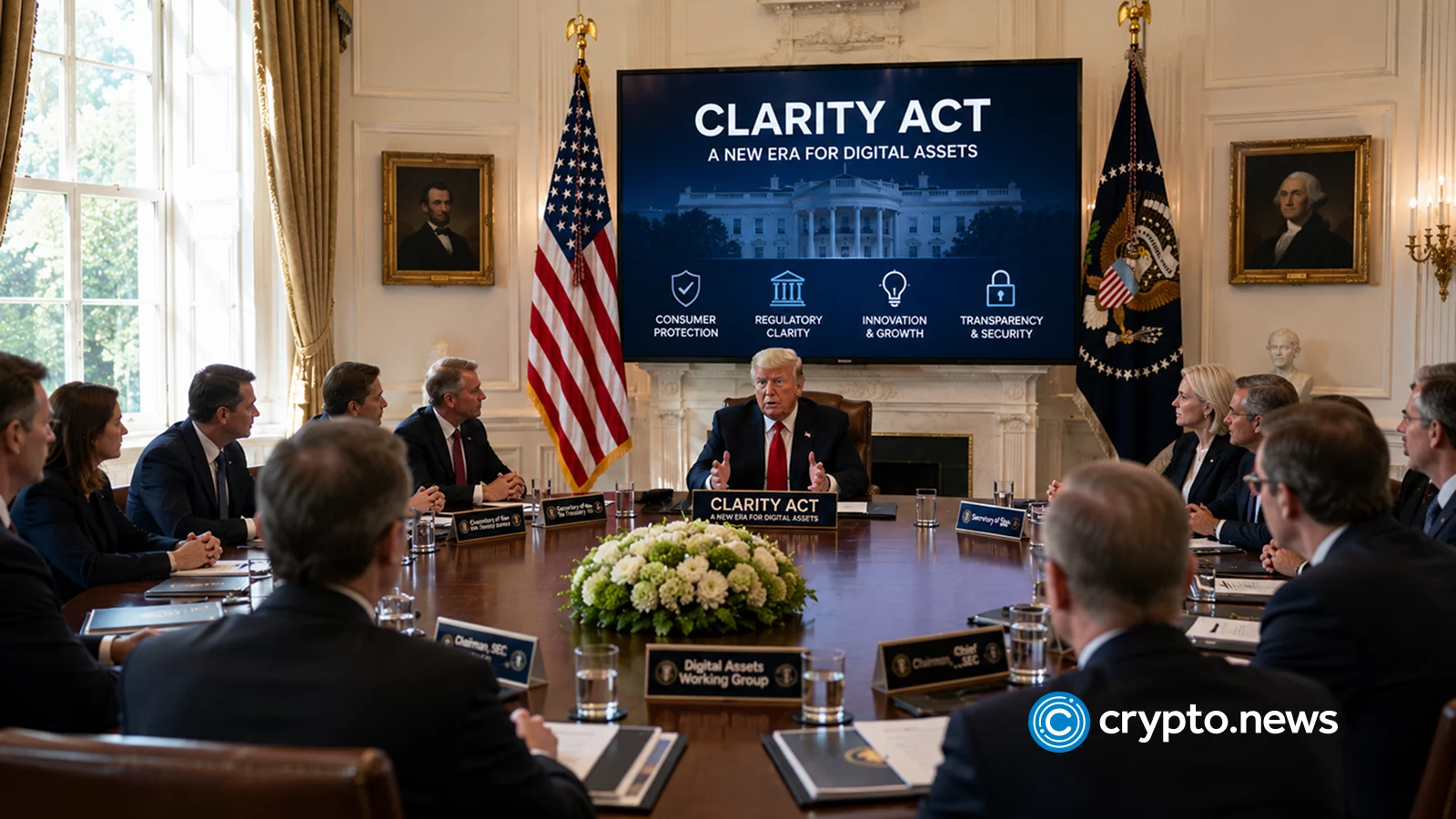
Coinbase, Ripple to join Aug. 19 White House crypto meeting
Coinbase and Ripple executives have been named among the expected attendees at an Aug. 19 White House meeting involving at least six crypto and prediction market companies.
Summary
- Six crypto and prediction market firms are expected to have representatives at the White House meeting.
- Coinbase, Ripple, a16z, Chainlink, Paradigm, and Kalshi are among the reported participants.
- The CLARITY Act faces a Sept. 15 procedural vote requiring at least 60 Senate votes.
- CFTC advisers will meet one day later to discuss crypto, AI, and prediction markets.
Semafor reporter Eleanor Mueller said executives from Coinbase, Ripple, a16z, Chainlink, Paradigm and Kalshi were expected to attend the White House meeting, citing people familiar with the plans.
The report did not identify the individual executives who will represent each firm. Coinbase CEO Brian Armstrong and Ripple CEO Brad Garlinghouse have both supported the Digital Asset Market Clarity Act, which remains stalled in the Senate after lawmakers left Washington for their August recess.
President Donald Trump may attend with members of his administration, according to the original report supplied for this story. However, an earlier crypto.news report said the White House had not released a formal participant list and that Trump’s attendance remained unclear.
CFTC Chairman Michael Selig and SEC Chairman Paul Atkins are also expected to participate, according to people familiar with the planning. Neither the White House nor the two regulators had published a formal agenda for the meeting at the time of writing.
Coinbase and Ripple bring CLARITY Act interests
For Coinbase and Ripple, the meeting comes before a scheduled Senate test for legislation that could decide how the two main U.S. market regulators divide responsibility for digital assets.
The CLARITY Act would place spot markets for qualifying digital commodities under CFTC oversight while keeping crypto assets classified as securities within the SEC’s authority. It would also establish federal requirements for exchanges, brokers, dealers, advisers, and digital asset custodians.
American investors could be directly affected by that division because a token’s regulatory status can determine where it may trade, which disclosures apply, and whether a platform must register with the SEC or comply with CFTC market rules.
Coinbase has supported the legislation while continuing to raise concerns about provisions governing stablecoin rewards and decentralized finance. In an Aug. 7 statement, Armstrong called the Senate delay disappointing but said adoption would continue regardless of Congress’ timetable.
“The momentum behind this technology keeps growing with or without a congressional calendar,” Armstrong said.
An Aug. 8 report on Armstrong said the Coinbase chief pointed to stablecoin use, tokenized assets and perpetual futures as areas where activity could continue while lawmakers negotiate. He also argued that a consistent federal framework could support investment and offer stronger protections for U.S. consumers.
Garlinghouse has also backed the bill during negotiations. Ripple and Coinbase were part of a coalition of more than 120 companies that urged lawmakers to advance the proposal in April, according to a May report on Garlinghouse.
Andreessen Horowitz, better known as a16z, has also supported the legislation, while Chainlink works with financial companies on blockchain infrastructure. Paradigm invests in crypto businesses and is a backer of Kalshi, a CFTC-regulated prediction market operator.
CLARITY Act faces a Sept. 15 Senate test
Senate Majority Leader John Thune filed cloture on the motion to proceed with the CLARITY Act before the chamber began its August recess. The Senate Daily Press schedule says the motion will ripen at 2:15 p.m. on Sept. 15, one day after senators return for regular business.
The procedural vote would not pass the bill or send it to Trump. Clearing cloture would allow the Senate to begin formal consideration, after which lawmakers could debate the proposal, introduce amendments, and hold a separate vote on final passage.
At least 60 senators must support cloture. Republicans cannot reach the threshold alone, making Democratic votes necessary even if most Republican senators back the measure.
The House approved its version in July 2025 by a 294–134 vote, with 78 Democrats joining Republicans. In May 2026, the Senate Banking Committee advanced its part of the legislation by a 15–9 vote after Democratic Sens. Ruben Gallego and Angela Alsobrooks voted with Republicans.
Any text approved by the Senate that differs from the House measure would require another House vote or negotiations between the two chambers before reaching the president.
Unresolved disagreements include political ethics provisions, rules for rewards paid on stablecoin balances, protections for software developers, illicit finance controls, and consumer safeguards. The White House has not said whether any of those subjects will appear on the Aug. 19 meeting agenda.
Prediction markets remain doubtful about passage
Prediction markets have continued to price in a low chance that the CLARITY Act will become law in 2026, even as the Senate prepares for its September procedural vote.
Polymarket traders placed the probability at 19%. Since such contracts trade continuously, the figure has moved as participants respond to the White House meeting reports and the Senate timetable.
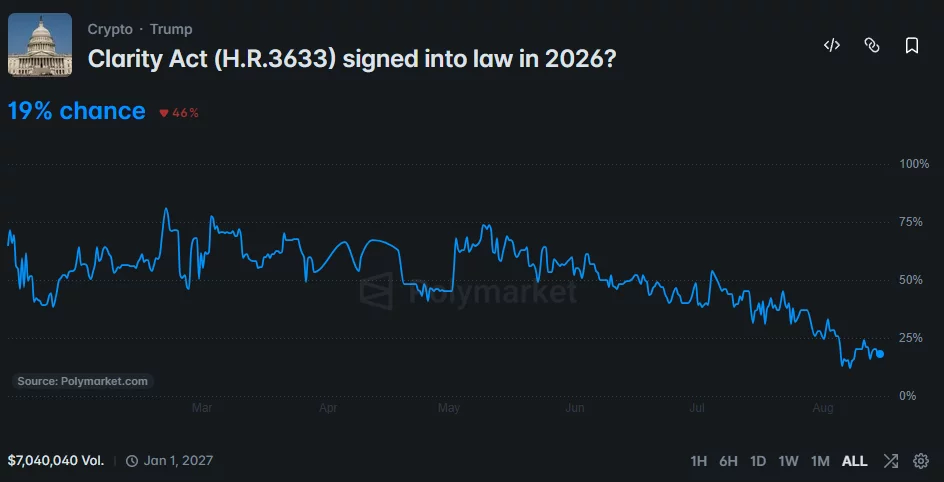
On Aug. 14, the contract briefly showed a 21% probability, rising from 17% one day earlier. Another recent reading placed the chance at 16%, down from an 82% peak in February.
Galaxy Research reportedly assigned a 10% chance of passage during 2026, citing unresolved policy disputes and the limited number of Senate working days before the midterm election recess.
A separate Kalshi contract provided a more favorable reading for an earlier procedural event. As of Aug. 11, traders assigned an 88% probability that the Senate would vote on the legislation before Oct. 1, with about $1.23 million traded on the contract. The date aligns with Thune’s Sept. 15 cloture schedule but does not indicate whether senators will ultimately approve the bill.
CFTC meeting will follow on Aug. 20
People involved in the planning have described the White House event as a kickoff for the CFTC Innovation Advisory Committee’s first meeting, which is scheduled for Aug. 20 in Washington.
According to the CFTC’s published agenda, the three-hour session will run from 1 p.m. to 4 p.m. Eastern time. Committee members will attend in person, while the public will be able to watch the proceedings online.
The first 50-minute panel will examine the history of crypto regulation, state licensing requirements, overlapping jurisdictions, and the lack of a complete federal market structure framework. Members will also discuss how the CFTC could modernize existing rules within its current legal authority and support future legislation from Congress.
A second session will cover artificial intelligence in trading, compliance, surveillance and risk management, including autonomous systems capable of carrying out transactions or managing portfolios.
During the final panel, members will examine prediction markets, event contracts, market surveillance, manipulation risks, and customer protections. The agenda also lists questions involving federal and state authority, an issue directly relevant to Kalshi and other regulated event-contract platforms.
The advisory committee will not vote on a proposed crypto rule, and its recommendations do not automatically become CFTC policy. Members of the public may submit written statements about the meeting through Aug. 27, with qualifying submissions entering the public record.
Separately, the SEC canceled an Aug. 14 open meeting that had been scheduled to consider a proposed offering framework for certain crypto-related investment contracts. The agency’s cancellation notice did not provide a reason or announce another date.