
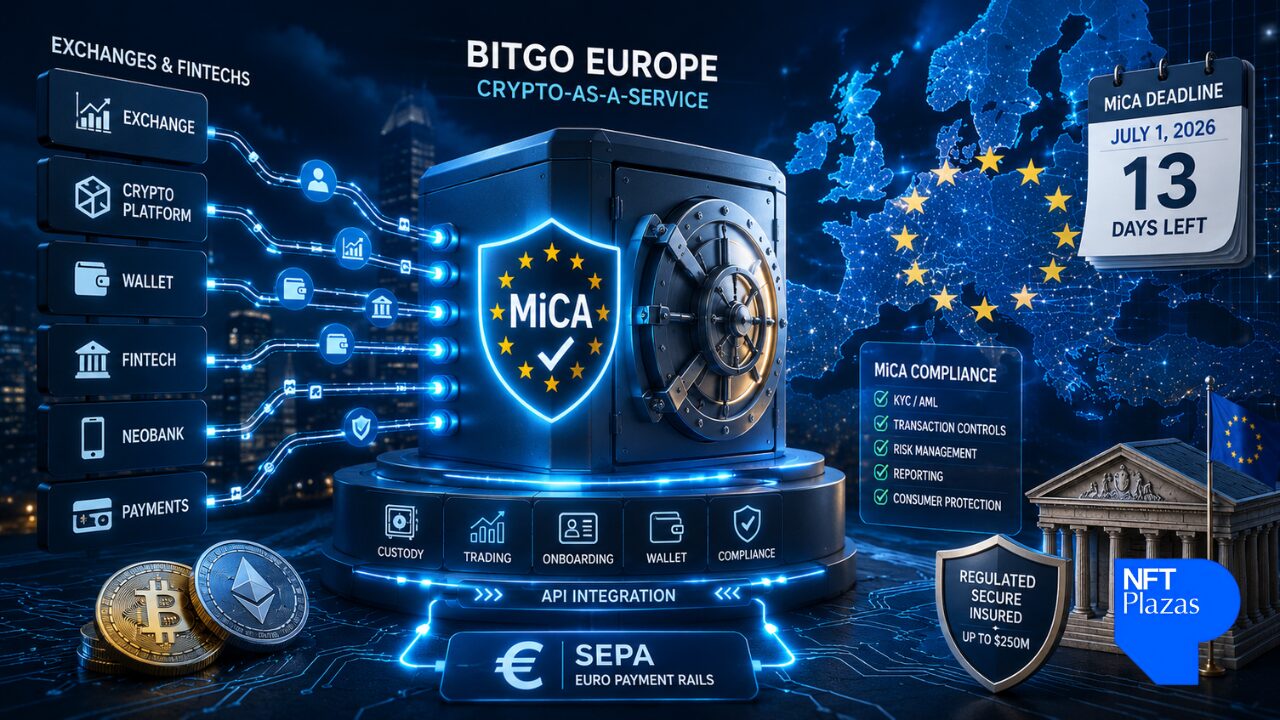
BitGo Europe Launches MiCA-Ready Crypto-as-a-Service Platform as EU Deadline Closes In
The custody firm is offering exchanges and fintechs a compliance bridge just 13 days before the EU’s July 1 MiCA authorization deadline — a lifeline for hundreds of firms still operating without licenses.
BitGo Europe has unveiled a Crypto-as-a-Service (CaaS) platform designed to help crypto businesses maintain regulatory compliance across the European Union’s 30-nation Economic Area, arriving at a critical moment as the bloc’s Markets in Crypto-Assets Regulation enters its final enforcement phase.
The launch comes as the EU’s July 1 MiCA deadline approaches, requiring crypto companies to obtain authorization to continue serving customers across the bloc. For firms that have not yet secured their own Crypto-Asset Service Provider (CASP) licenses, the platform offers a path to continued operation rather than a forced shutdown.
A Franchise Kitchen for Compliance
The product is called Crypto-as-a-Service, and it functions like a franchise kitchen model: a firm that does not hold its own MiCA CASP authorization can plug its client base into BitGo’s licensed infrastructure. Client wallets migrate into BitGo sub-accounts held in segregated storage; the partner firm retains the customer relationship, handles support, and runs its own product layer, while BitGo sits underneath as the regulated entity of record.
Through its crypto-as-a-service offering, BitGo provides access to regulated custody, trading, onboarding, and wallet infrastructure via application programming interfaces (APIs). The platform also includes SEPA euro payment rails for eligible regions, programmatic KYC checks, and transaction controls — all capabilities central to satisfying MiCA’s ongoing compliance requirements, not merely its one-time licensing paperwork.
CEO Mike Belshe explained that businesses running wallet operations without MiCA authorization can link their platforms to BitGo’s system, and that customer relationships remain with the originating companies throughout onboarding. “All of your clients can be onboarded and have sub-accounts inside of BitGo,” he said, adding that businesses retain control over support and product offerings while BitGo handles compliant asset custody.

BitGo CEO Mike Belshe Statement
Crucially, eligible businesses may also continue to evaluate or pursue their own MiCA-focused CASP licenses in parallel while integrating BitGo Europe’s infrastructure. The platform is framed explicitly as a bridge, not a permanent substitute for full authorization.
The Scale of the Problem
The timing of the launch underscores a sector-wide authorization crisis. More than 3,000 crypto firms were registered across Europe before MiCA, yet only 194 had secured authorization by May 2026. Law firm Hogan Lovells estimates that around 75% of pre-MiCA registered crypto firms could lose their registration status as transition periods expire.
Poland represented more than 1,400 of those registrations alone. National transition rules have added further complexity: in Lithuania, the transition period for legacy virtual asset service providers ended on December 31, 2025, while in Poland, implementation remains unresolved, leaving companies navigating unclear timelines for how national approvals will map into the new EU system.
EU crypto compliance lawyers have identified three realistic survival paths for non-authorized firms facing the cliff: obtain authorization, cease EU servicing, or partner with an already-licensed CASP that can white-label services under its own license while an application is processed. BitGo is commercializing that third option directly.
BaFin Authorization as the Commercial Asset
BitGo’s regulatory positioning is central to the platform’s value proposition. BitGo Europe GmbH received its MiCA license from Germany’s BaFin on May 12, 2025, and that single license functions as a passport across the entire European Union and European Economic Area, covering 30 countries in total. A September 2025 extension added regulated trading services, enabling passported operations across all 30 EEA countries — and that passporting is the commercial asset BitGo is now monetizing.
By early March 2026, BitGo had expanded its crypto-as-a-service platform to cover all 30 EEA nations, with services including custody, asset transfers, trading infrastructure, and fiat payment system integration, all accessible through APIs designed for banks and fintech companies. Custody services come with insurance coverage up to $250 million.
On pricing, Belshe said it starts at “a couple of $1,000 a month” at minimum and scales with volume, with clients able to choose between variable plans using per-transaction fees or static plans with a fixed monthly fee and lower per-transaction costs.
Major Players Under Pressure
The platform’s launch arrived alongside mounting uncertainty for some of the industry’s largest venues. Questions around MiCA authorization have affected some of the industry’s largest players, with crypto.news reporting that Binance’s MiCA application in Greece was expected to face rejection — a development that could affect the exchange’s ability to serve customers across the EU under MiCA’s passporting system. Binance maintained that it had satisfied the necessary requirements and had received no formal indication that its application would be denied.
Whether BitGo’s infrastructure could serve as a stopgap for platforms facing rejected applications remains an open question the company has not publicly addressed.
Institutional Adoption Pattern
The EEA rollout reflects a wider pattern among European financial institutions choosing to partner with specialized crypto firms rather than build custody infrastructure internally, following MiCA implementation. Deutsche Bank is moving toward crypto custody through partnerships with Bitpanda’s technology unit and Swiss digital asset provider Taurus. Spain’s BBVA has said it will rely on Ripple’s institutional custody platform for Bitcoin and Ethereum trading and safekeeping, citing MiCA compliance.
“We believe Europe is moving toward a more unified and durable regulatory framework for digital assets,” CEO Belshe said. “BitGo was built for moments like this. With BitGo Europe, we are giving businesses a way to meet the MiCA standard while continuing to serve the market with confidence.”