
Bitcoin’s Bounce to $64,000 Wipes out $320 Million in Crypto Shorts in 15 Minutes
Key Takeaways
- About $320 million in crypto shorts were liquidated in 15 minutes as bitcoin rebounded toward $64,000.
- The squeeze followed a 2026 low near $59,100 and weeks of long liquidations topping $1.5 billion.
- Heavy leverage and thin liquidity have historically left the market prone to violent swings in both directions.
A 15-Minute Short Squeeze
A little over $320,000,000 in shorts were liquidated from the crypto market in a single 15-minute window as prices snapped higher. Liquidations of this nature occur when an exchange forcibly closes a leveraged position that can no longer meet its margin requirements, and a sharp price move can trigger them in clusters.
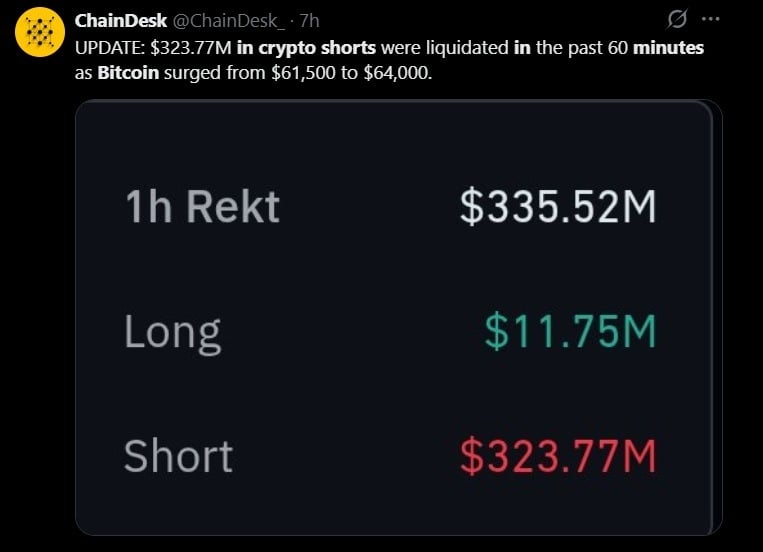
In this case, traders who had bet on further downside were squeezed as bitcoin reversed. The forced buy-backs that accompany short liquidations can feed on themselves, pushing the price up faster and liquidating still more shorts in a chain reaction that traders call a short squeeze.
The $320 million figure landed as bitcoin climbed back toward $64,000, extending a recovery from the lowest levels of the year. While large in isolation, the number was modest next to the long-side losses that defined the preceding week.
From Long Wipeouts to a Short Squeeze
The episode flipped the script on a punishing stretch for bulls with Bitcoin.com News reporting last week that the market had just absorbed $1.57 billion in liquidations as BTC’s price slid below $60,000 (with long positions bearing the brunt of the damage). Consequently, Coinglass data also showed hundreds of thousands of traders flushed out over the span of the last 10-days.
Bitcoin had bottomed near $59,100 on June 5, its lowest mark since February, before staging the rebound. Momentum indicators had flashed deeply oversold conditions, with one widely watched gauge, the relative strength index ( RSI), collapsing to 16 as prices consolidated near $61,000.
That combination left the market vulnerable to a violent snapback because, as soon as a rebound arrived, that same leverage accelerated the sell-off, punishing the shorts that had crowded in near the lows.
A Market Primed for Whipsaws
Repeated liquidation cascades in both directions point to a market still carrying heavy leverage on thin liquidity. Each large move forces a wave of closures that tends to overshoot, setting up the next reversal. Traders often describe these conditions as a “ liquidation engine,” in which price hunts the densest clusters of stop levels on either side of the book.
The pattern is a warning as much as an opportunity, given outsized leverage magnifies gains on the way up and losses on the way down, and the speed of the latest move ($320 million in a quarter of an hour) shows how little time over-leveraged traders have to react before they are closed out.
For perpetual-futures traders, the cost is not only the lost margin but also the funding swings that follow. As shorts are squeezed, funding rates can flip sharply positive, raising the cost of holding long positions and seeding the conditions for the next flush in the opposite direction.
If the ongoing bounce holds will hinge on broader catalysts, including the geopolitical and macro forces that drove the original sell-off. A sustained move higher could keep squeezing late shorts, while a failure to hold recent gains would once again expose stretched longs.