
Big Banks Demand Identity Checks for Secondary Stablecoin Markets
Key Takeaways
- Major banks urged FinCEN to extend strict identity requirements to secondary stablecoin markets.
- This would force retail and decentralized exchanges to collect user data under the Bank Secrecy Act.
- FinCEN notes this is practically challenging due to blockchain anonymity and the lack of central data.
Big Banks Ask For Customer ID Requirements to Be Extended to Secondary Stablecoin Markets
The Bank Policy Institute (BPI), a member organization that groups banking behemoths like JPMorgan, Bank of America, Wells Fargo, and Citi, among others, has proposed extending identity requirements to secondary stablecoin markets.
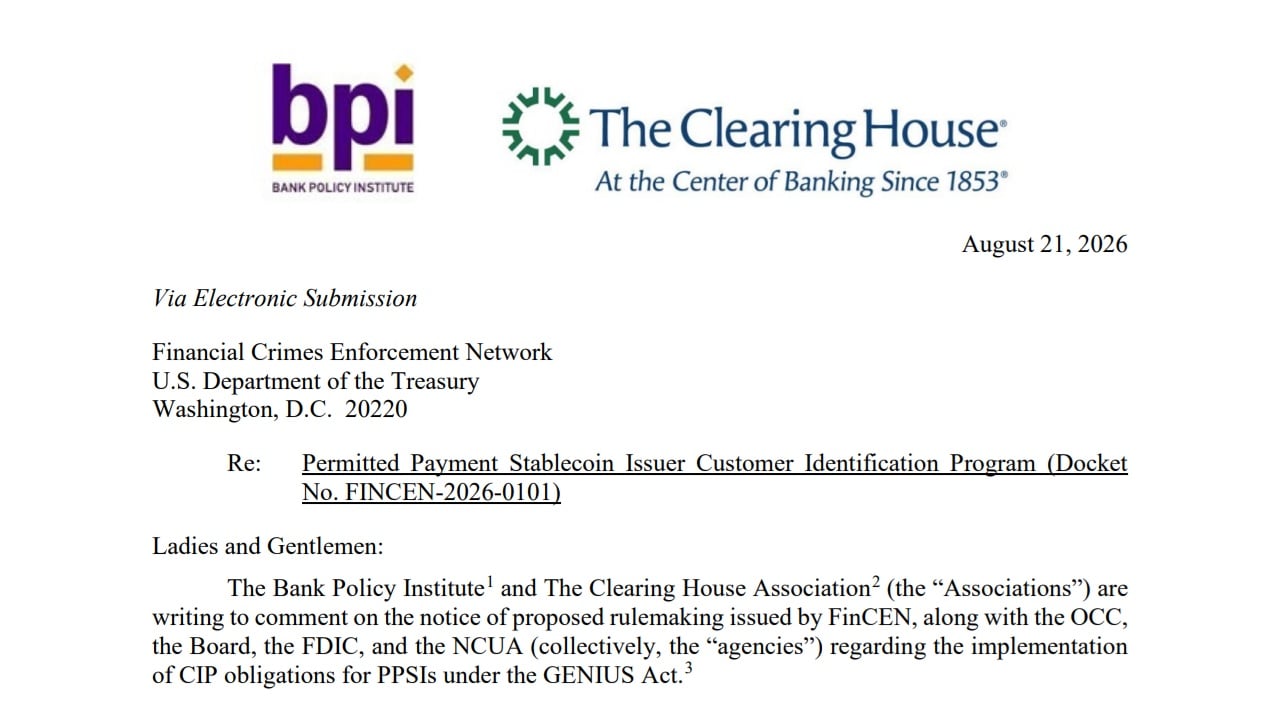
In a comment letter on the “Permitted Payment Stablecoin Issuer Customer Identification Program” proposed by the U.S. Department of the Treasury’s Financial Crimes Enforcement Network (FinCEN), the group called for applying the Customer Identification Program (CIP) provisions to exchanges and other platforms that directly interact with retail customers and are not under the proposed rule’s oversight.
The BPI stressed that these organizations “play a significant role in the payment stablecoin ecosystem, facilitating a significant portion of the purchase and sale of payment stablecoins,” where it argues that most illicit activity involving stable assets takes place.
The letter recommended that the proposed rule should specify that exchanges and other platforms establishing account relationships with customers to facilitate stablecoin activity are “subject to CIP requirements under the Bank Secrecy Act (BSA).”
If included in the rule, the new provision would put an additional burden on issuers, as the proposed rule itself explains that expanding the information collection to secondary markets would be “practically challenging,” even if it would offer significant benefits.
Decentralized exchanges, referred to as “various types of decentralized market participants” in BPI’s recommendations, would also be included under the secondary market oversight umbrella.
Nonetheless, the proposed rule recognizes that, for secondary market customers trading stablecoins on the blockchain itself, identities are “often anonymous or pseudonymous.”
“Blockchains are by nature decentralized algorithms, so there is often no central collection point at which identifying information is collected,” the rule explains, adding that “issuers have a limited ability to collect customer information on the secondary market.”
In May, the BPI, alongside other banking organizations, rejected the current version of the Digital Asset Market Clarity Act, as it failed to plug “loopholes” that could be exploited to allow the distribution of activity-based yield for stablecoin users.