
A 66-Million-Year-Old Tooth Shows T. Rex Ran Almost as Warm as a Human Body
Key Takeaways
- A UCLA team’s Science Advances study used clumped isotopes in T. rex tooth enamel to estimate the dinosaur’s body temperature at about 97°F (36°C).
- That sits above modern reptiles (82 to 86°F) but below birds (104 to 109°F), pointing to a warm-blooded predator that ran cooler than its bird descendants.
- Staying warmer than its surroundings may explain how T. rex could range across North America, including the Arctic.
The best thermometer for Tyrannosaurus rex may have been in its mouth. A study published on 9/16/2026 in Science Advances used chemical signatures locked inside fossil tooth enamel to estimate how hot the predator ran, landing at about 97 degrees Fahrenheit, nearly a human body temperature. “No one’s been able to make a temperature measurement like this before,” UCLA geobiologist Robert A. Eagle said, after the team drilled tiny enamel samples, dissolved them in phosphoric acid, and read the resulting gas in a mass spectrometer. The UCLA group says the teeth point to an animal that stayed warmer than its surroundings, strengthening the long-running case for warm-blooded tyrannosaurs.
Unearthing a dinosaur’s temperature
One of the most surprisingly “modern” numbers in science landed this fall: 97 degrees Fahrenheit. A study published on September 16, 2026, in Science Advances used chemical signatures locked inside fossil teeth to put a direct estimate on how warm Tyrannosaurus rex likely ran in life, roughly matching a human body.
For decades, researchers have argued over whether big dinosaurs were warm-blooded or more reptile-like. This work is notable because it moves beyond inference and into measurement, the kind of step-change you usually see when new lab techniques mature and finally get applied to an old, stubborn question.
What tooth enamel can store for 66 million years
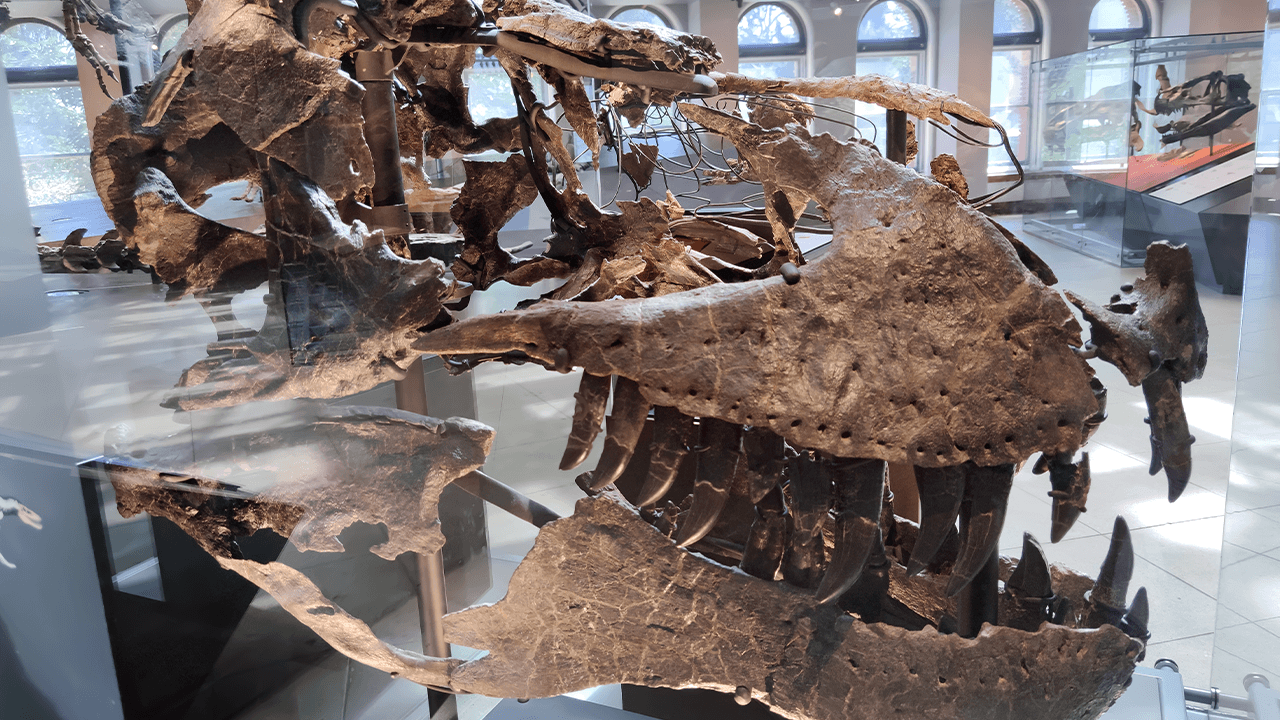
The study was led by UCLA geochemists Randon J. Flores and Robert A. Eagle, who analyzed three T. rex teeth to estimate body temperature. Two of those teeth came from a skeleton nicknamed “Thomas,” held at the Natural History Museum of Los Angeles County and preserved to about 70% completeness.
The core trick: tooth enamel preserves rare “clumped” bonds between carbon and oxygen isotopes, and the abundance of those clumps rises in cooler temperatures and falls in warmer ones. Enamel’s big, durable crystals resist chemical change over millions of years better than bone does, making it an unusually reliable archive for this kind of forensic chemistry.
The lab work behind the headline number
To read that temperature signal, Flores and Eagle used a dental drill to collect tiny enamel samples, dissolved the powder in phosphoric acid, then measured the carbon dioxide gas with a mass spectrometer. Eagle summed up the moment plainly: “No one’s been able to make a temperature measurement like this before.”
The result landed at about 36°C, or 97°F. Eagle put it even more directly: “We found T. rex was 36°C (97°F), about the same as humans.” The authors noted they could not completely rule out seasonal bias, though samples from different parts of the Thomas teeth produced statistically indistinguishable temperatures.
Warm-blooded, but not bird-hot
That 97°F estimate sits above modern cold-blooded reptiles, which typically run around 82 to 86°F, but below birds, which often clock 104 to 109°F even though they’re evolutionary descendants of dinosaurs. The middle ground matters, because it suggests tyrannosaurs generated substantial internal heat without necessarily operating like today’s high-octane birds.
UCLA professor and co-author Aradhna Tripati connected the physiology to geography: “What the teeth tell us is that T. rex was warmer than the environment around it,” and “A warm-blooded T. rex is a T. rex that can go almost anywhere on the continent, including the Arctic.” The study adds to cold-tolerance evidence like a T. rex footprint found in Alaska in 2022.