
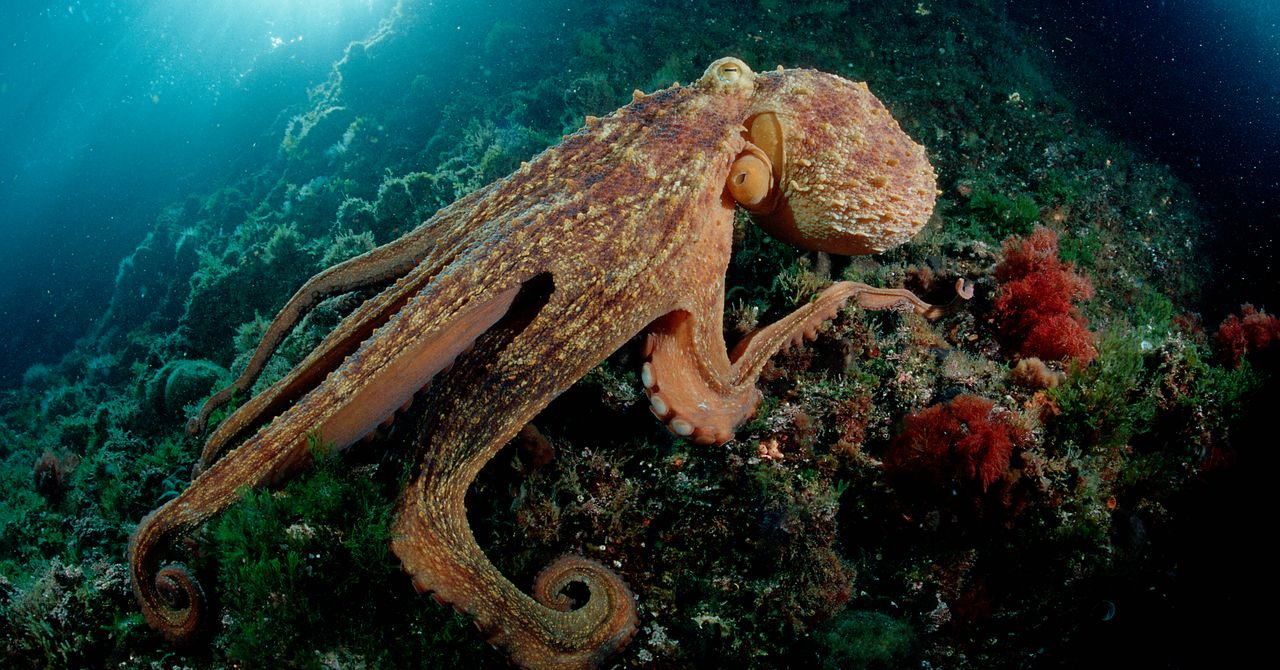
Octopuses Use a Multi-Step Process to Squeeze Into Tiny Spaces
Squeezing your body into the tiniest possible space is no easy task, but it can be very useful, especially if you’re a soft-bodied creature living in the fiercely competitive ocean. Octopuses are the masters of this kind of contortion, being able to squeeze through just about any opening wider than their beaks. Not only is it an impressive feat, but scientists are interested in this ability because it could aid in the design of biologically inspired robots.
In a recent study published in the Journal of Experimental Biology, researchers uncovered the process octopuses go through to squish themselves into small spaces. Before this, “there [was] no information about how octopuses squeeze through an opening far smaller than the body diameter,” Wen-Tzu Hsing, first author of the study, said in a press release.
The research team set up a tank divided by a transparent acrylic panel with a hole in it, allowing the octopus to move through the hole to the other side. They classified the openings as large or small depending on whether the octopuses would have to squish the stiff cartilage structure that protects their central nervous systems, which the researchers could estimate by measuring the distance between their eyes.
What surprised the scientists was the slightly different approaches octopuses used when moving through gaps of different sizes. When the gap was on the larger side, the process involved three distinct steps. First, the creatures would explore the hole with their arms. They’d then usually insert two arms through to the other side before threading their other arms and mantle through the hole. Often, this final step involved suckering the arms that led the way to the barrier for increased leverage.
The three step process octopuses use to move through larger gaps.Video: Michael Kuba
However, when the holes got smaller, the octopuses opted for a four-step process instead. The process was the same up to the second stage—where several arms were threaded through the opening—but the subsequent movements differed slightly. For a smaller opening, the octopus would rotate its body upward and push the bases of the arms that had already passed through deeper into the hole to widen the passage. From that position, it twisted and stretched its arms to feed all of them through. Then, once all appendages were on the other side, the octopus slid its head through, also using its tentacles on the barrier for leverage.
In the 30 successful attempts to pass through the hole observed in this experiment, the octopuses never used this four-step sequence when presented with the large hole. Additionally, side-view footage confirmed that during the last step of moving through a small opening, the octopus deforms its mantle to reduce its diameter. The octopuses also had a preference for which arms they used for the various steps.
An octopus deforming its mantle to reduce the diameter.Video: Michael Kuba
These experiments were conducted with juveniles from two species, the common octopus and the Maya octopus. The researchers therefore don’t know whether these processes hold true across other octopus species, but beyond the strictly biological world, the researchers suggest that these findings could be useful for the design and control of soft robots.
In environments where the size of passageways cannot be predicted—such as among debris at disaster sites—robots used for search and rescue must be designed to fit through the narrowest passages. Consequently, many existing robots adopt a long, slender, snake-like shape; however, miniaturization inevitably comes at the expense of sensors and operational capabilities. The research team hopes to apply the insights gained from the octopus in this experiment to the control of soft robots designed to search disaster debris or explore difficult terrain.
This story originally appeared on WIRED Japan and has been translated from Japanese.