A starquake 10 billion years ago may have just sent a flash to Earth
A split-second flash of radio waves traveled through space for more than 10 billion years to reach Earth, making it the farthest fast radio burst anyone has detected and confirmed.
Fast radio bursts, or FRBs, last only a few thousandths of a second but release enormous amounts of energy. Scientists spotted the first one in 2007, and they still don’t know what causes them. Most flash only once, which makes them extremely hard to chase.
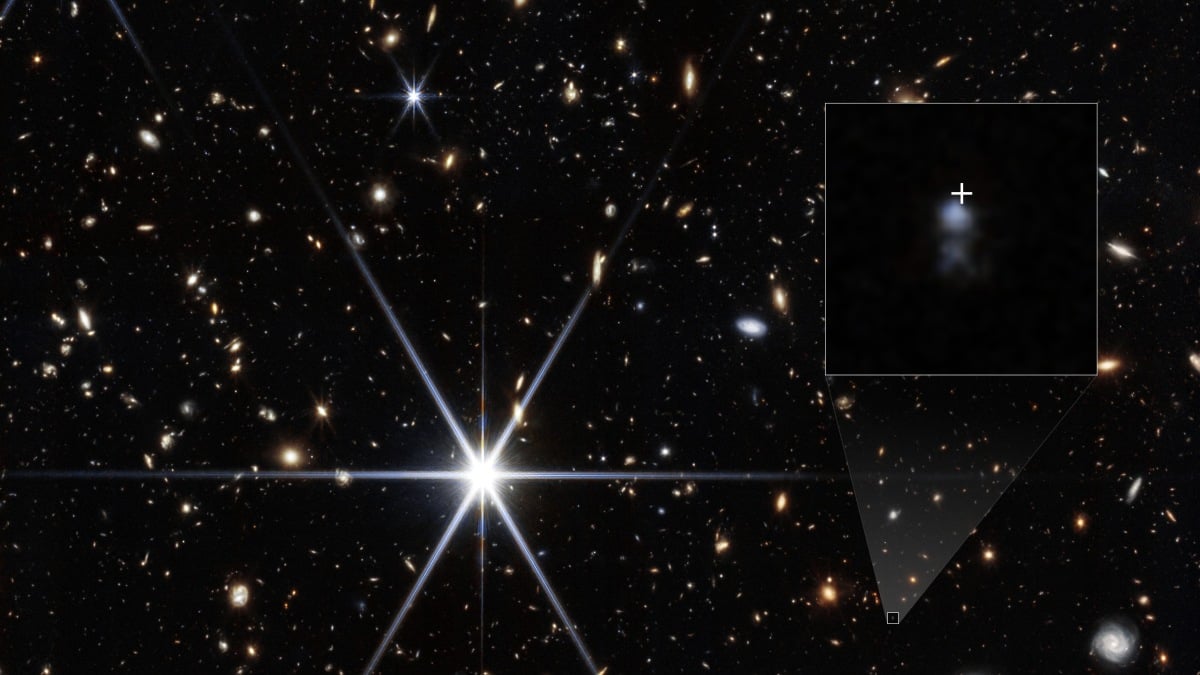
South Africa’s MeerKAT radio telescope caught this one, dubbed FRB 20240304B, on March 4, 2024. After failing to find its origin with the world’s largest ground-based telescopes, the team, led by Manisha Caleb and Themiya Nanayakkara of the University of Sydney in Australia, turned to NASA‘s James Webb Space Telescope. Finally, it came into focus: a faint galaxy from when the universe was only about 3 billion years old — more than double the distance of the prior record.
Until now, astronomers mostly managed to find and measure the sources of bursts much closer to home. This one shows researchers can trace bursts much farther back in time, turning them into tools for exploring the early universe.
The galaxy itself surprised the team. Most bursts come from big galaxies, but this one has about 1,000 times less mass than expected. The researchers have published their findings in the journal Science.
“We thought it would be a big, nicely formed galaxy with lots of stars, and instead it was a little dwarf galaxy, although it was actively forming stars,” Caleb said.
Mashable Light Speed

The MeerKAT radio telescope in South Africa detected the fast radio burst on March 4, 2024. The James Webb Space Telescope later confirmed its host galaxy.
Credit: South African Radio Astronomy Observatory
This galaxy existed during a period known as “cosmic noon,” an era when the universe as a whole made stars much faster than at any other time. That youth seems to offer a clue about what causes these bursts, according to the research.
Want more science and tech news delivered straight to your inbox? Sign up for Mashable’s Light Speed newsletter or get Mashable push alerts today.
Scientists have had two leading ideas for what causes the bursts, both involving neutron stars — the crushed, ultra-dense cores left behind by giant dying stars when they explode. One hypothesis says bursts happen when two neutron stars circle each other and eventually collide. But that slow merger takes billions of years, so they would likely show up in mature galaxies.
The other hypothesis points to magnetars — young neutron stars with powerful magnetic fields. That magnetism puts a huge strain on the star’s solid outer crust. If the crust suddenly fractures, like Earth’s crust in an earthquake, the “starquake” could release a burst of radio waves.

A magnetar’s solid iron crust cracks during a starquake.
Credit: NASA Goddard Space Flight Center / S. Wiessinger / Fermi illustration
In this scenario, bursts from magnetars could happen in young, star-forming galaxies like this source galaxy. The host for FRB 20240304B also contains few heavy elements, another sign of its early age that fits with a magnetar. For this reason, the team argues that magnetars are a likely explanation for at least some fast radio bursts, especially this one.
Catching these flashes takes a special kind of telescope. Radio waves are a form of light that our eyes can’t see. Many objects in space give off radio waves, too, and giant dishes like MeerKAT can collect them, revealing activity that other telescopes miss.
This particular burst did double duty. As it crossed space, it carried an imprint of the matter it passed through. The signal revealed a previously unknown galaxy cluster, about 3.5 billion light-years away. It also picked up the much closer Virgo cluster.
“A fast radio burst is almost like a cosmic flashlight,” said co-author J. Xavier Prochaska of the University of California, Santa Cruz, in a statement. “It lights up everything along the path.”