[Coinfest Asia] Ex-Central Banker Turned Binance Exec Explains Why Crypto Can’t Just Move Fast and Break Things in Asia
For years, Silicon Valley’s “move fast and break things” was the go-to strategy of the crypto industry. It was simple: launch a platform globally, blitzscale past competitors, and ask for regulatory forgiveness later.
This is an interview conducted during Coinfest Asia 2026. Check out more Coinfest coverage here. For more interviews, click here.
That playbook turned platforms into global giants, but it also brought companies into a wall of legal reckonings.
Under CEO Richard Teng, a veteran regulator, the largest crypto exchange in the world is preaching a completely different philosophy.
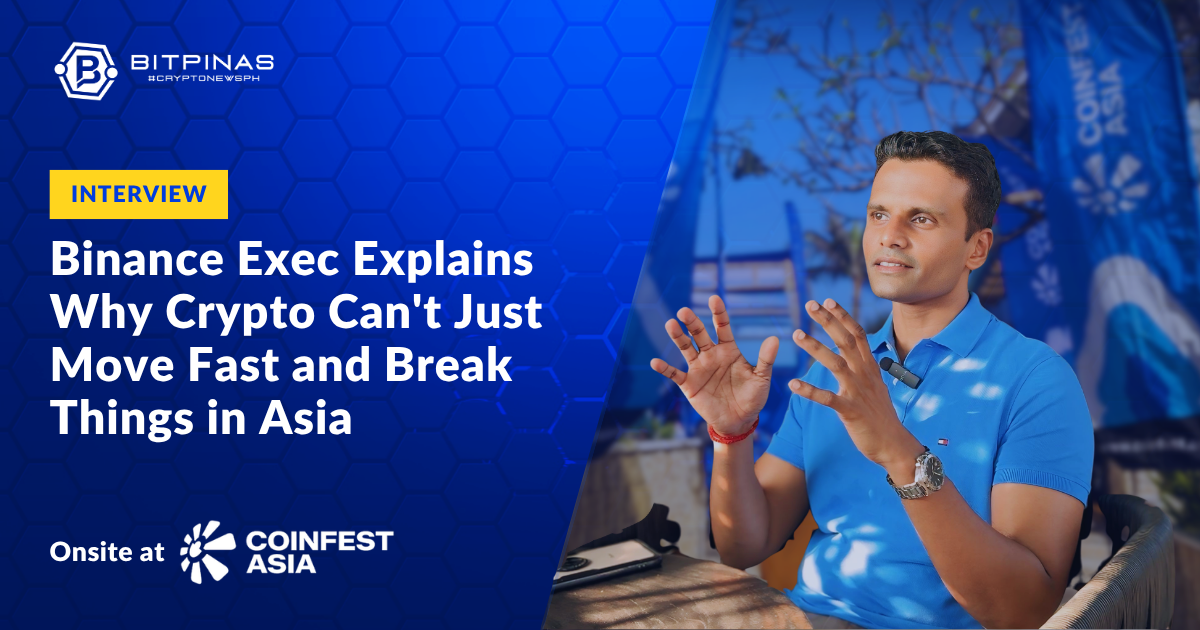
In my interview during Coinfest Asia with SB Seker, a former Monetary Authority of Singapore (MAS) regulator and legal counsel turned Binance executive, he explained why the “move fast and break things” approach no longer works in Southeast Asia, and why building a lasting crypto business requires playing by local rules.
The End of the “One-Size-Fits-All” Crypto Playbook
![Photo for the Article - [Coinfest Asia] Ex-Central Banker Turned Binance Exec Explains Why Crypto Can't Just Move Fast and Break Things in Asia](https://bitpinas.com/wp-content/uploads/2026/08/SB-Seker.jpg "[Coinfest Asia] Ex-Central Banker Turned Binance Exec Explains Why Crypto Can't Just Move Fast and Break Things in Asia 2")
Early internet ventures often treated Southeast Asia as a single, homogenous region, deploying identical business models across multiple countries.
In crypto, that meant launching a single global website and expecting retail users from Bangkok to Jakarta to onboard seamlessly.
According to Seker, that model is dead.
“Every country, largely, will have its own priorities,” Seker said, noting that while security, privacy, and compliance controls can be standardized globally, local product offerings must be tailored specifically to what regional regulators expect.
This pivot comes after years of friction between global exchanges and Asian regulators. In the Philippines, for instance, the Securities and Exchange Commission (SEC) issued advisories and network blocks against unlicensed foreign exchanges, including Binance, for targeting local residents without domestic licenses. In Vietnam, it will start penalizing users who will used unregulated exchanges.
Overcoming those hurdles, Seker said, requires abandoning aggressive blitzscaling in favor of early, proactive dialogue with local authorities to understand the policy intent behind local laws. Binance, via a local partnership, has returned to the Philippines.
Why Crypto Won’t Destroy Traditional Stock Markets
As crypto exchanges offer 24/7 trading, instant settlement, and fractionalized access to assets, traditional financial institutions have felt growing pressure. In markets like the Philippines, observers have questioned whether 24/7 digital asset platforms could eventually render traditional stock exchanges obsolete.
Seker dismisses the idea that crypto platforms will simply wipe out traditional players.
Instead of a single platform “ruling them all,” Seker foresees a collaborative division of labor:
- Traditional Finance (TradFi): Handles the legal custody, securitization, and issuance of real-world assets (RWAs).
- Crypto Exchanges: Act as the global distribution layer to be leveraged for high liquidity, user-friendly interfaces, and round-the-clock availability.
“I honestly feel that there’s enough space for all market participants to have a role to play,” Seker explained. He emphasized that tokenizing traditional assets like stocks or commodities requires deep partnerships with licensed traditional institutions rather than trying to bypass them.
The Real Bottleneck is Local Talent
For Seker, building smart contracts or deploying trading engines is no longer the hardest part of scaling a crypto exchange in Asia. The real challenge is finding human talent that understands both local regulatory nuance and high-growth technology.
With traditional financial giants entering the digital asset space, competition for compliance, legal, and operational experts has become hyper-competitive.
Even as artificial intelligence tools like ChatGPT and specialized legal AI begin automating basic document processing and regulatory analysis, Seker argues that human judgment remains irreplaceable in high-stakes regulatory navigation.
“When you’re dealing with a crisis, a problem, or a tricky situation, you still intuitively want to speak to another human being who has experience and is a domain expert,” Seker noted.
This article is published on BitPinas: [Coinfest Asia] Ex-Central Banker Turned Binance Exec Explains Why Crypto Can’t Just Move Fast and Break Things in Asia
What else is happening in Crypto Philippines and beyond: