Michael Saylor Declares Bitcoin Has ‘No Spam Problem’ as BIP-110 Debate Escalates
Key Takeaways
- Michael Saylor’s Jul. 9 X post drew 938 replies, exposing deep Bitcoin community divisions.
- Grok found 65% opposed Saylor’s stance, while 25% backed his free-market Bitcoin view and 10% showed neutrality.
- BIP-110’s August rollout could reshape Bitcoin as the spam debate continues to intensify.
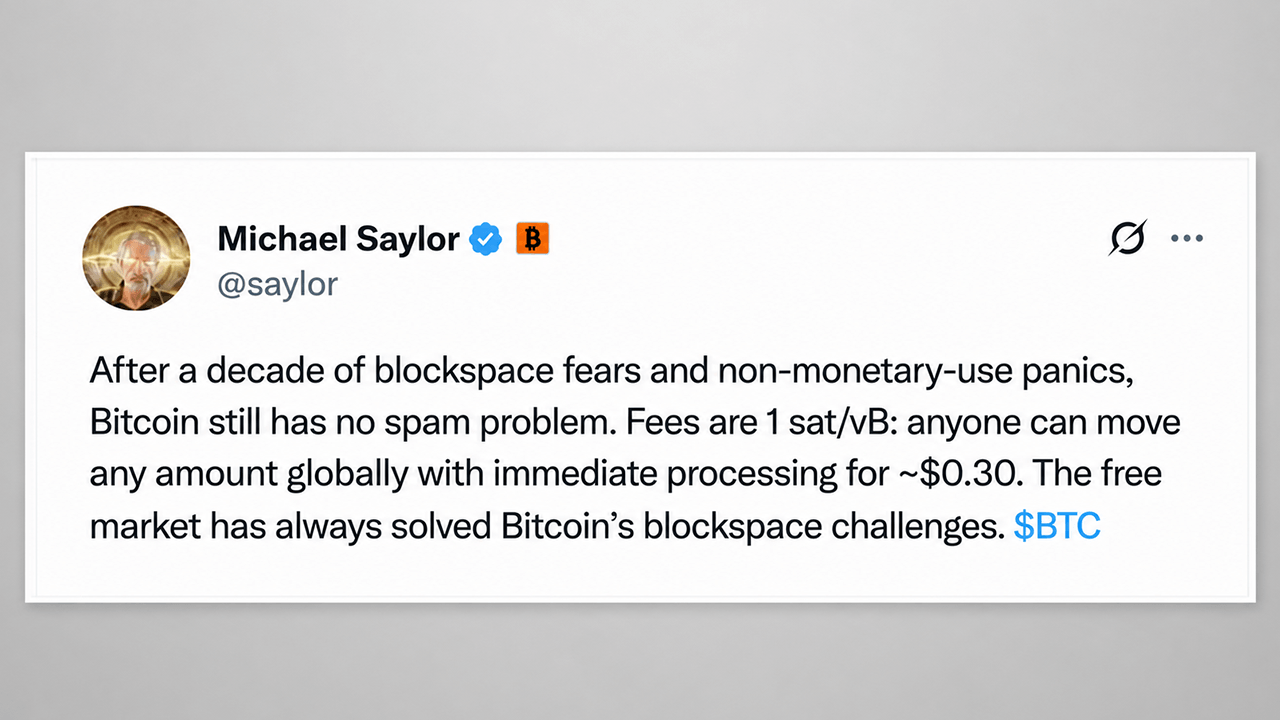
On Wednesday, Michael Saylor took to the social media platform X to share his thoughts on the Bitcoin network. As of Jul. 9, 2026, at 9 a.m. EDT, Saylor’s post had been reposted more than 1,100 times, received 7,700 likes, and generated more than 757,000 impressions. 938 X accounts replied to Saylor’s post.
Saylor stated:
“After a decade of blockspace fears and non-monetary-use panics, Bitcoin still has no spam problem. Fees are 1 sat/vB: anyone can move any amount globally with immediate processing for ~$0.30. The free market has always solved Bitcoin’s blockspace challenges.”
Saylor’s Comments Arrive as BIP-110 Debate Intensifies
Saylor’s post was accompanied by a screenshot from Clark Moody’s Bitcoin Dashboard showing onchain fees at just 1 sat/vB. The Strategy executive’s remarks arrive as the Bitcoin community wrestles with an increasingly contentious debate over BIP-110, a proposed soft fork scheduled to begin rolling out in August.
Bitcoin.com News has covered the BIP-110 proposal extensively, while speculation over its potential outcome continues to build. BIP-110, also known as the Reduced Data Temporary Soft Fork, targets what proponents describe as “spam” on the Bitcoin blockchain and seeks to halt Ordinals inscriptions, BRC20 tokens, certain Taproot-based transfers, and virtually all forms of arbitrary data.
Community Interprets Saylor’s Remarks as a Rejection of BIP-110
While Saylor’s post does not explicitly mention BIP-110, it appears to align with the view that spam is not a problem on the Bitcoin network. According to a Grok query, the post has been widely interpreted as implicitly, or even directly, opposing BIP-110-style interventions in favor of allowing the fee market and existing filters to manage the issue.

After analyzing more than 50 responses to Saylor’s post, Grok found that roughly 65% were negative, largely from BIP-110 supporters who disagreed with his position.
Roughly 25% of the responses supported Saylor or his free-market stance opposing BIP-110 intervention, while the remaining 10% were neutral.
One of the more prominent critical replies to Saylor’s post, which had attracted 210 likes at the time of writing, stated, “ Node runners still have to store all of the garbage spam, making it harder to run a node. Nodes make Bitcoin what it is!”
The X account added:
“This is very disappointing to read. Run Knots + BIP-110 everybody! Bitcoin is a monetary network, and Saylor has lost the plot…Or never had it.”
Prominent Bitcoin Voices Split Over the Proposal
Another X user, Magdalena Gronowska, also known as @Crypto_Mags, was sharply critical of the movement behind BIP-110. “The BIP 110 movement has boiled down to ‘but think of the children,’ which is not an effective strategy with bitcoiners that are sick of this type of government overreach,” Gronowska wrote. The pseudonymous bitcoiner and creator of Ord.io, Leonidas, described Saylor’s comment as:
“Another massive L for BIP-110.”
The Debate Reveals a Deep Divide Over Bitcoin’s Future
The 938 replies reflect a vocal and deeply divided response from a sizable segment of the Bitcoin community focused on “spam” and blockchain bloat concerns, with negative sentiment outweighing positive reactions in the most visible manner. Broader engagement, including likes and views, indicates that many others either agree with Saylor’s position or are largely indifferent to it.
At the same time, the exchange captures a familiar chapter in Bitcoin governance debates: technically driven, passionately argued, and far from settled.