
FIFA World Cup fans warned as crypto linked scam sites emerge
Crypto scammers have set up at least three World Cup-related fraud operations linked to four cryptocurrency addresses as millions of fans prepare to attend the 2026 FIFA World Cup, according to blockchain intelligence firm TRM Labs.
Summary
- TRM Labs identified fake World Cup ticketing sites and a fixed match betting scheme linked to four cryptocurrency addresses.
- U.S. authorities and FIFA have warned fans against buying tickets through unofficial websites as phishing and fraud campaigns increase ahead of the tournament.
- The scams emerged as the 2026 FIFA World Cup opened across the U.S., Canada and Mexico, with about 6.5 million attendees expected.
TRM Labs said it identified two fake ticketing websites and a fixed-match betting scheme that were already targeting football fans as the tournament opened on Thursday across the United States, Canada and Mexico.
FIFA expects roughly 6.5 million attendees during the competition and projects a global economic impact of about $40.9 billion, creating a large market for ticket purchases, travel bookings and betting activity.
“Criminals always look to exploit major events and cultural moments and they don’t wait until kickoff,” Ari Redbord, global head of policy at TRM Labs, told Cointelegraph. Redbord said fraud operators typically establish their infrastructure weeks before a major event and expand their activity once public attention reaches its highest point.
According to Redbord, cryptocurrency transactions also provide investigators and compliance teams with opportunities to trace suspicious activity before losses spread further.
Authorities have already warned of World Cup scams
Weeks before the tournament began, U.S. authorities had already raised concerns about World Cup-themed fraud campaigns.
In a July 4 warning, the Los Angeles County Sheriff’s Department said criminals were promoting fake World Cup tickets, hospitality packages, merchandise offers, streaming subscriptions and sports betting deals through websites and social media accounts designed to resemble legitimate FIFA services.
Law enforcement officials noted that requests for payment through cryptocurrency, wire transfers, gift cards and other hard-to-recover methods often serve as warning signs of fraud. Fans were urged to purchase tickets only through FIFA’s official channels and avoid links distributed through social media posts, text messages and messaging applications.
Security concerns have extended beyond ticket sales. The Sheriff’s Department said attackers were creating websites that closely imitated official FIFA pages in an attempt to collect payment details, login credentials and other personal information.
Separately, the FBI also warned in May that threat actors were spoofing FIFA-related websites ahead of the tournament. According to the agency, those operations were designed to gather personal data, sell counterfeit tickets and carry out additional malicious activity.
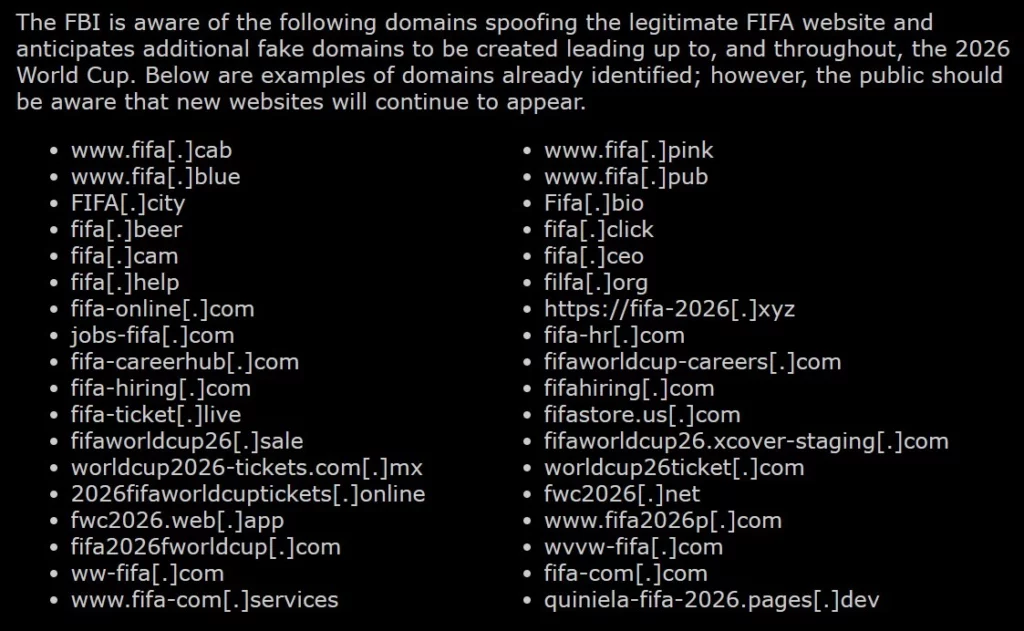
Fake domains impersonating FIFA website. Source: FBI
FIFA has also cautioned supporters against purchasing tickets through unofficial sources. The organization said tickets obtained outside its official platform could be invalidated or cancelled without notice.
Ticket demand has become a focal point as the tournament gets underway.
The Council on Foreign Relations reported that several opening matches in the United States and Canada had not sold out on FIFA’s platform as of Monday. Meanwhile, the Financial Times reported that official resale portals still listed about 176,000 unsold group-stage tickets earlier this week.
While legitimate tickets remain available through official channels, TRM Labs’ findings suggest fraud operators are attempting to capitalize on fan demand through counterfeit sales and betting-related schemes.
The latest warning arrives during a year of rising crypto-related fraud. According to blockchain analytics firm Chainalysis, cryptocurrency theft has already reached $3.4 billion in 2026.