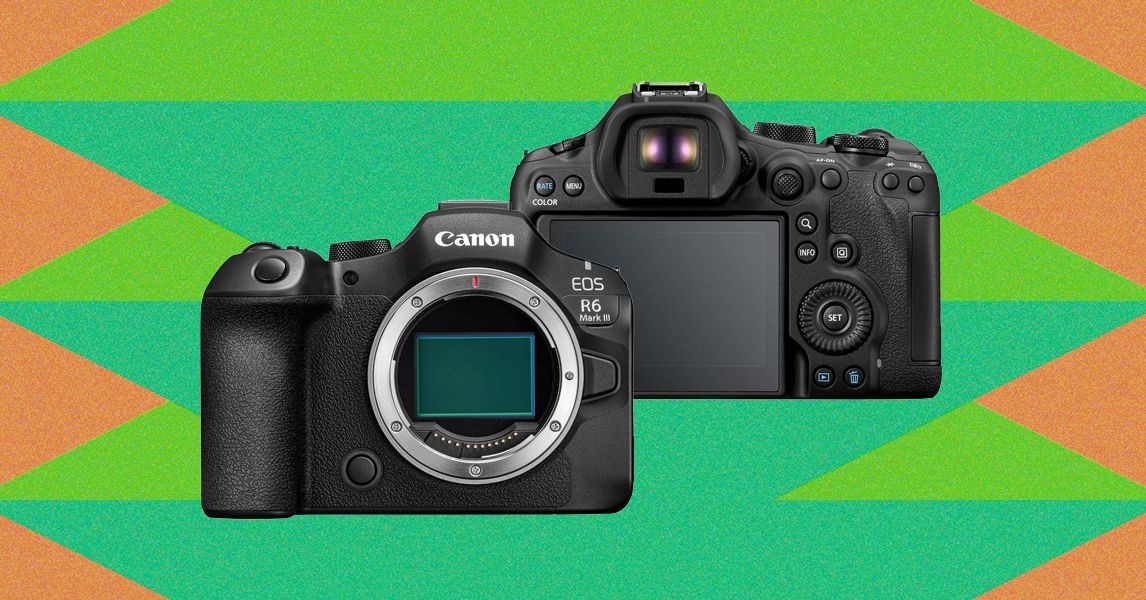
Canon EOS R6 Mark III Review: A Serious Upgrade
Canon has, however, missed the opportunity to add a mode dial lock while redesigning. Inadvertently knocking the mode into the wrong settings is one of my biggest pet peeves with my Mark II, and the same is true with the Mark III. It’s probably not a big issue for general shooters, but when the Mark II (or III) is in a dual-camera harness, it has a tendency to knock against my waist and slip into the wrong mode. Now imagine quickly reaching for your camera to grab that split-second moment at a wedding, whether it’s a first kiss, confetti throw, or family member’s reaction, and you can see why having a feature that allows the camera to slip into the wrong mode is a huge drawback.
The EVF and LCD displays carry over from the previous model, which is disappointing—we’ve yet to see a four-axis LCD from Canon that can go head-to-head with the brilliant ones seen in Sony’s latest cameras. The 3-inch, 1.62m dot LCD can tilt and flip out to get most of the angles you’d want to shoot from. Sadly, there’s also still no top LCD screen to quickly see your settings; these seem to be reserved for the top-of-the-line EOS R1, R3, and R5 series cameras.
Speed Demon
Canon’s EOS R6 Mark II was no slouch in the speed department, but the new Mark III takes it to a whole new level. Though the 12 frames-per-second (fps) mechanical and 40 fps electronic burst rates of the two models are identical on paper, remember that the Mark III’s 32.5 MP full-frame chip has a third more pixels to process, plus it’s able to record 20 full-res RAW frames half a second before the shutter is pressed when using Pre-Continuous Capture. This made photographing birds at the precise moment of takeoff from a perch so much easier, and I think bird, sports, and action photographers will really love using it. While the Mark II had this feature, it can now be assigned to the M-Fn button to make it easier to turn on and off when needed. Speaking of this button, it’s more spongy than the prior model, which was more “clicky.” I found it a bit more vague as to whether I’d pressed the button or not, but it is now virtually silent, so wildlife photographers will no doubt appreciate this subtle change.
One thing missing is Canon’s Digic Accelerator, which means the R6 III doesn’t get Action Priority Auto Focus (AF), so it won’t be quite as good for contact sports such as soccer, basketball, or volleyball. There is, however, support for the Nominate Register People Priority, pulled from the higher-end R1 and R5 cameras. As the name suggests, this allows you to register faces so the camera knows who to prioritize when there are multiple people in shot. This is great not only for sports photography, where you want the star players to be in sharp focus, but also for events like weddings, where you’re looking to prioritize the bride, groom, and close family members. I’ve spent many hours with Canon’s EOS R1, R5 Mark II, and R6 III, and I don’t think many will be disappointed with the R6 III’s performance when it comes to sports. The AF is super sticky and responsive, and if you want to take pictures of your child playing in a Sunday league, the Register People Priority will be enough to ensure you’re tracking your key players and bagging sharp shots. Obviously, if you’re shooting sports professionally, the R5 II or R1 will be a better option for you.