
Raoul Pal Says a Bitcoin Supercycle Is More Likely Than Ever in 2026
Key Takeaways
- Raoul Pal sees rising supercycle odds driven by debt monetization and the largest capex boom in history.
- Bitcoin’s 90% correlation with global M2 suggests significant upside if liquidity expands as Pal expects.
- Pal’s price target of $450,000 per BTC hinges on central banks injecting liquidity by end of 2026.
What Is Driving Pal’s Supercycle Thesis?
Raoul Pal, the founder of Real Vision and one of the most closely followed macro voices in crypto, posted on X Sunday that he sees a “rising probability” that markets are entering a supercycle, one that is sustained and a multi-year bull run unlike any seen before. The catalyst, he argues, is not the bitcoin halving or retail sentiment, but the structural mechanics of global debt markets.
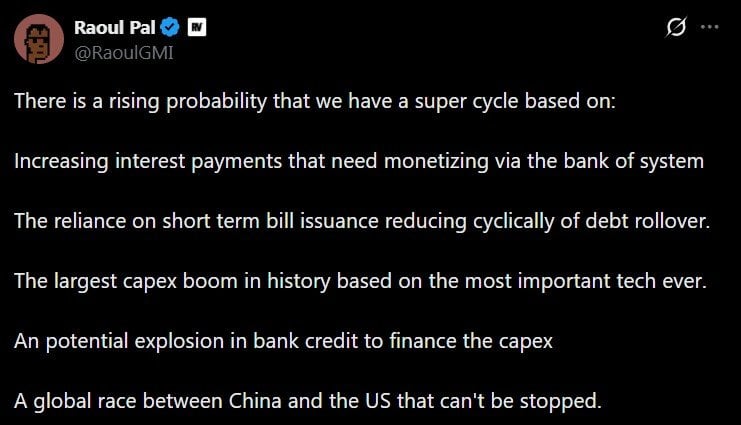
According to Pal, governments are increasingly relying on short-term bill issuance to manage their debt loads, which reduces the cyclicality of traditional debt rollover windows. When those bills come due, central banks are effectively forced to inject liquidity into the system to avoid systemic stress. That liquidity, historically, flows into risk assets, with bitcoin leading the charge.
“Every four years, global debt rolls over, and central banks are forced to pump liquidity to avoid systemic collapse,” Pal previously explained. That cycle, which he has extended from four to five years, now appears to be aligning with the largest capital expenditure (capex) boom in modern history.
Why Pal Believes This Cycle Could Be Different
Infrastructure, artificial intelligence, and energy transition investment, Pal says, are adding fuel to the macro fire, fast. Moreover, he has long argued that bitcoin’s price is 90% correlated with global M2 money supply, meaning that when the money printer runs, bitcoin tends to run harder.
At the last Sui Basecamp, he put a price target of $450,000 on bitcoin if the supercycle thesis plays out, though he has consistently framed these as probabilistic scenarios rather than certainties.
Bitcoin is currently trading around $81,000, down from its 2025 peak above $124,000 but still holding comfortably above the $80,000 mark. Pal’s supercycle argument, if correct, would imply the current price represents a buying opportunity rather than a cycle top.
The broader macro backdrop lends support to his view. U.S. interest payments on the national debt have climbed to levels not seen in decades, and the Federal Reserve faces mounting pressure to ease financial conditions. Meanwhile, global liquidity indicators tracked by analysts suggest M2 is expanding again, consistent with previous bitcoin bull phases.
Bitcoin.com News has reported previously on Pal’s view that crypto now functions as a leading indicator for U.S. fiscal stress, a thesis gaining traction as traditional financial institutions increasingly hold digital assets on their balance sheets.
Whether Pal’s supercycle materializes remains to be seen. But with sovereign debt dynamics tightening, capex at record highs, and liquidity cycles aligning, the argument is gaining credibility even among skeptics.