
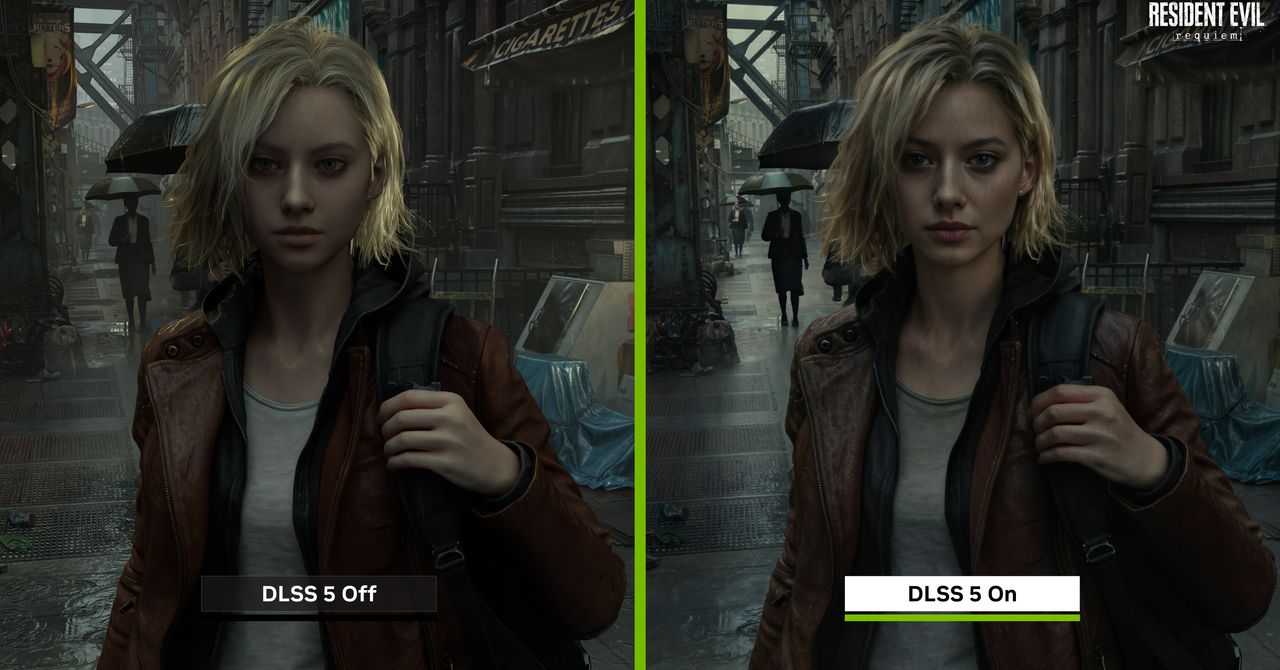
Gamers Hate Nvidia’s DLSS 5. Developers Aren’t Crazy About It Either
After a day of widespread, overwhelming pushback, Nvidia CEO Jensen Huang doubled down and said gamers are “completely wrong” about DLSS. (You know how much gamers love being told that they’re wrong.) But developers at Capcom and Ubisoft say they didn’t even know what the tech demo would look like and, according to Insider Gaming, found out about it the same time everyone else did and were just as surprised. (Nvidia, Ubisoft, and Capcom did not immediately get back to our request for comment.)
“I think the reaction from gamers is understandable,” Marwan Mahmoud, a game developer at Incrypt, wrote in an email to WIRED. “Some games started relying too heavily on these technologies instead of focusing on proper optimization. From a developer perspective, it feels a bit different, because you see DLSS as a tool that helps rather than a core solution.”
The problem for many people, developers included, is the one-size-fits-all approach of a technology that can adjust visuals across various game types.
“The artist has a style, the artist has an art direction that you’re going to give him, and that’s something that AI kind of doesn’t respect all the time,” says Raúl Izquierdo, an indie game developer in Mexico, “Maybe I don’t want my characters to be yassified.”
Bates agrees, saying he doesn’t think every game needs to be photoreal. And that sentiment is also echoed by game developer Sterling Reames, who has worked at Striking Distance Studios and Zynga. “People just want better games,” Reames wrote in a message to WIRED. “That’s as plainly as I can put it.
At GTC, Nvidia ran its demo on its most powerful consumer graphics cards, two GeForce RTX 5090s. Had Nvidia made its selling point for the tech that it saves resources, thus enabling older hardware to deliver more impressive graphics, there may have been something to that.
“What’s the point if you’re not going to do it on weaker hardware?” Izquierdo says. “If this were done on an [RTX 2080 graphics card], for instance, I think I would be thinking differently about it. OK, this is for the betterment of gamers’ experiences and everything, not just for selling graphic cards.”
Ultimately, Nvidia’s demo, and GTC writ large, was a flex of the company’s power in the AI space. The reaction, Bates posits, is more about humans dealing with not just crossing the uncanny valley, but what happens when we reach the other side.
“Right now it’s pretty clearly a thing they are forced to do to demonstrate their prowess as an AI company,” Bates says. “But the truth is, this is going to be the default in a few years, and nobody is even going to think twice about it. It’s Jensen’s world, we’re just living in it.”